Thursday, August 11, 2011

Review: Ophelia - Lisa Klein

Synopsis: He is Hamlet, Prince of Denmark; she is simply Ophelia. If you think you know their story, think again.

In this re-imagining of Shakespeare's famous tragedy, it is Ophelia who takes center stage. A rowdy, motherless girl, she grows up at Elsinore Castle to become the queen's most trusted lady-in-waiting. Ambitious for knowledge and witty, as well as beautiful, Ophelia learns the ways of power in a court where nothing is as it seems. When she catches the attention of the captivating, dark-haired Prince Hamlet, their love blossoms in secret. But bloody deeds soon turn Denmark into a place of madness, and Ophelia's happiness is shattered. Ultimately she must choose between her love for Hamlet and her own life. In desperation, Ophelia devises a treacherous plan to escape from Elsinore forever . . . with one very dangerous secret.

Review: When I first read this book several years back, I didn't much like it because there are very few redeeming characters and quite a few sexual references. But I decided to give it a second chance, now that I am older and far more familiar with Hamlet, and more appreciative of the purposefully flawed characters therein.

My opinion has not changed drastically, but it has changed enough to make me keep it among my collection, rather than selling it as I had first intended. There are just as many sexual references as I recall, including two bedroom scenes, but the Author gracefully turns away from details and merely mentions that yes, they did it - let's move on, and she words it far more delicately than I did just then. Early on, a character pursues Ophelia with one intent only: to deprive her of virtue, but I assure you than nothing comes of it, and while the Author mentions a few more details than are necessary, she keeps even this to the smallest amount of words. Ophelia's going from childhood into womanhood (i.e. puberty) is mentioned with as much delicacy, and not dragged out into unnecessary details.

The majority of characters are flawed, but let us recall this Ophelia is based off of Shakespeare's Hamlet, which is all about flawed people, so when reading this book, one must take on the perspective that one does when reading the play: don't read it for the characters, but for the story. Even so, the Author manages to deliver some truly redeeming moments, when Ophelia realizes her errors and tries to amend them as best she can; when she determined to protect the life of her child; and finally, the Author presents us with Horatio, Hamlet's faithful friend, whom everyone will adore in the book. She plays upon all of his potential and really brings him to life.

Though I do rather wish Lisa Klein had toned down the sexual overtones, I have to admit that she handled them well nonetheless, and she offers us an ending far more redeeming and satisfactory than the ending of Hamlet. Had it not ended happily, where the villains and no-goods get the comeuppance and the good characters face their flaws and get on with life, I would have hated this book. But I would say that the ending alone makes it worth reading.

Overall Rating: 
JJJ

Saturday, August 6, 2011

Review: The Vespertine - Saundra Mitchell

Synopsis: The summer of 1889 is the one between childhood and womanhood for Amelia van den Broek - and thankfully, she's not spending it at home in rural Maine. She's been sent to Baltimore to stay with her stylish cousin, Zora, who will show her all the pleasures of city life and help her find a suitable man to marry.

With diversions ranging from archery in the park to dazzling balls and hints of forbidden romance, Victorian Baltimore is more exciting than Amelia imagined. But her gaiety is interrupted by disturbing, dreamlike visions she has only at sunset - visions that offer glimpses of the future. Soon, friends and strangers alike call on Amelia to hear her prophecies. Newly dubbed "Maine's Own Mystic," Amelia is suddenly quite in demand.

However, her attraction to Nathaniel, an artist who is decidedly outside of Zora's circle, threatens the new life Amelia is building in Baltimore. This enigmatic young man is keeping secrets of his own - still, Amelia finds herself irrepressibly drawn to him. And while she has no trouble seeing the futures of others, she cannot predict whether Nathaniel will remain in hers.


When one of her darkest visions comes to pass, Amelia's world is thrown into chaos. And those around her begin to wonder if she's not the seer of the dark portents, but the cause of them.

Review: The Vespertine is strange and a little hard to follow. This isn't because it is poorly written, because it isn't. The writing style is pretty and well-done, conjuring tasteful and beautiful pictures of dresses, scenery, and people. But with the visions and other otherworldly elements, it feels very surreal and dreamlike, and sometimes I was not certain that I read it correctly. It just barely worked for this particular story.

What surprised me most was how clean the story was. The entire time, from the very beginning to the very end, I expected someone to sleep with someone else (the main characters, mostly), but this never happens, and instead the Author just spends a lot of time describing Nathaniel and how his touch makes Amelia feel, which gets tiring in its own right, but it could have been worse. I admit that I hoped Nathaniel would end up being some creep with a villainous agenda of his own, because I found Nathaniel to be very disturbing and untrustworthy from the beginning, but as time wore on, I grew to like him a little bit more, though I was never fully supportive of his and Amelia's love. It reminded me far too much of the bizarre and rather wrong relationship of Cathy and Heathcliffe in Wuthering Heights. However, I believe that the Author intended that, so I was able to accept it.

Overall, I found The Vespertine interesting, and I will probably buy it, though it is not at the top of my list. I liked the writing style enough to ignore the majority of the storyline. I would neither recommend nor dissuade someone from reading The Vespertine, but I would warn them that it doesn't have much of a storyline.

Overall Rating: 
JJJ

Others in This Trilogy:
1)The Vespertine
2)The Springsweet

Friday, August 5, 2011

Review: The Twin's Daughter - Lauren Baratz-Logsted

Synopsis: Lucy Sexton is stunned when a disheveled woman appears at the door one day . . . a woman who bears an uncanny resemblance to her own beautiful mother. The two women are identical twins, separated at birth and raised in dramatically different circumstances: one as a member of high society, the other in a workhouse. Lucy's mother quickly resolves to give her sister the kind of life that she had never known, and the transformation in Aunt Helen is remarkable. As time goes by, Lucy herself transforms into a young woman, falling in love with a childhood friend she was once sure she hated. But in what should be a happy household, something is very, very wrong. And as Aunt Helen and Lucy's mother become ever more indistinguishable, Lucy begins to suspect that her aunt's now familiar face may mask a chilling agenda.

Review: This story had a lot of potential for being one of the best stories of mistaken identity and revenge I have ever read. The Author keeps things moving very well from the very beginning, dropping hints to a future twist that the Reader will not forget. Lucy is a witty, but proper, narrator who won't allow her Readers to miss out on the action. But here is where the good factors end.

Enter Kit (Christopher) Tyler, the main young man. I was dubious about the romance in this story from the beginning - I always am, just to be on the safe side. But I liked Kit; he was a very nice, honest boy. So I didn't understand why Lucy was such a jerk to him. It's like the Author wanted to have the whole modern trend of "heroine thinks she hates hero, treats him like garbage, then falls in love with him," but was conscious halfway through that such behavior did not suit Lucy's personality at all (it was really out of place), so rather than just rewriting it, she decided that Lucy gets over her sauciness very quickly and becomes fast friends with Kit. All this does is make Lucy seem bipolar.

Things progress downhill rapidly from there. The Author continues to maintain the suspense, and I spent the whole time thinking, Any minute now, things are going to be unveiled. Well, things are unveiled all right - far more things than need be, and not the sort of things that I was expecting. Let us start with female puberty, shall we? I am not a great advocate for putting such private, though natural, details in a story. No female wants to read a detailed account of a character going through female changes, and no male should know about it - and they certainly shouldn't learn about it from a book. Sometimes such things must be touched upon, but the Author of The Twin's Daughter did more than just touch upon it, all the while attempting to write it in delicate words, but there comes a point where one goes into so much detail that no amount of polite phraseology is going to rescue it.

Next up is the sexual content. For the most part, this remains in the "reference only" category, where things are alluded to when talking about certain people, and that is about it, with the exception of kissing scenes that start to progress into a little too much intimate touching and "mysterious" noises emitting from bedrooms. But in Chapter 42, page 366-369 we have an actual bedroom scene that is not horribly explicit, but comes so close to being thus that it's a wonder the Author didn't go into full-fledged descriptions. The only positive thing I can say about this absolutely unnecessary - and very private - scene is that at least the characters were married. But that gave me very little comfort, because books just should not include such intimate scenes even between married couples. Some things need to be left behind doors and not shared with the public, even in fiction. Leave it to the Reader to conclude that marriage usually leads to the sort of wonderful love that produces children, and don't literally spell it out.

Finally, the twist is revealed - and it is not at all what I was expecting. And I don't mean that in a good way. It reminded me of a perfect plot for a soap opera, actually, and in the end the characters are either completely immoral or go through a complete change of personality as to leave the Reader feeling like the only thing they can side with is that poor houseplant in the corner which has had to witness everything right along with you.

The Twin's Daughter could have been so good, but in the end, it is just one big letdown with way too many intimate moments that no one should have to read.

Overall Rating: 
N

Thursday, August 4, 2011

Review: In the Shadow of the Lamp - Susanne Dunlap

Synopsis: It's 1854, and Molly would give anything to change her circumstances as a lowly servant in a posh London house. So when she hears of an opportunity to join Florence Nightingale and her nurses in the Crimea, the promise of a new start - and perhaps even adventure - is too tempting to pass up.

The work is grueling, the hospital conditions are deplorable, and Miss Nightingale proves to be a demanding leader. But before long, tending to sick and wounded British soldiers becomes more than just a mission of mercy; it becomes a mission of the heart when Molly finds that she's falling love with not one, but two young men. With the battle raging ever nearer, one of the men will fall victim to the great guns. Will it be the dashing young doctor who sees Molly as more than just one of Nightingale's nurses, or the foot soldier who has left everything behind and joined the army to be near to her?

Review: I was, at first, uncertain whether or not this would be a good story with the "duel romance" element thrown in for good measure. In my experience, such details are only irksome and end up making the Reader hate everyone, and finally attaching themselves to That Guy because said Reader is fed up with everyone else.

The romance isn't as annoying as I was anticipating, but it wasn't my favorite. For once, however, I actually had nothing against the two men Molly Fraser finds herself mixed up with - Will Parker and Dr. Maclean. They were fine. Will was honest and gentle and clearly cared for Molly deeply, while Dr. Maclean cared for his patients and tried to do his best at his job. And while, for the most part, I liked Molly as a heroine, her indecision between the two got a bit on my nerves. Though both good young men, the infatuation between her and Dr. Maclean seemed rather sudden, while the relationship between her and Will felt right, and there was something just slightly off about Dr. Maclean that had me totally rooting for Will Parker. I saw it so clearly that I wanted to scream at Molly (and quite nearly did, but was reading in a public area and thought that maybe it would scare a few people if I yelled at the book), and towards the end of the book, I started to think her as a bit selfish for pushing aside Will's affections so many times because she liked the "danger" feeling she got around Dr. Maclean rather than the "safe" she felt around her friend.

However, this does not get in the way of the overall good storyline too much, and if I were not inclined to like both Dr. Maclean and Will, as well as Molly, I would say that it didn't belong. But it does because all three really are likable characters, and the Author wraps up the "love struggle" neatly and satisfactorily (managing to make it sad, but happy at the same time) in the end.

The writing is good, though not spectacular (I mean this as a compliment. Few authors' writing styles are spectacular; good is a thing to be proud up in a world where hardly anyone can write anymore). The Author conveys clearly the nitty-gritty of the hospital in the Crimea and the gristliness of the work therein, but without unnecessary details. I was able to munch on a molasses cookie easily enough while reading some of the meatier bits without my stomach flipping. Her historical detail is rich and accurate, though she takes a few acceptable liberties. While I knew quite a bit more about Florence Nightingale and the Crimean War before reading In the Shadow of the Lamp than most people, I find myself far more curious about it now, and intend to do some deeper research.

This book comes very recommended.

Overall Rating: 
{{{{

Wednesday, August 3, 2011

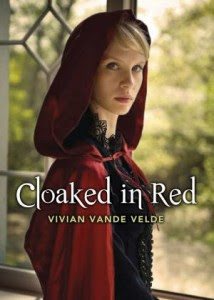
Review: Cloaked in Red - Vivian Vande Velde

Synopsis: So you think you know the story of Little Red Riding Hood, the girl with the unfortunate name and the inability to tell the difference between her grandmother and a member of a different species? Well, then, try your hand at answering these questions:


- Which character (not including Little Red herself) is the most fashion challenged?


- Who (not including the wolf) is the scariest?


- Who (not including Granny) is the most easily scared?


- Who is the strangest? (Not we're not "not including" anyone, because they're all a little off.)


- Who (no fair saying "the author") has stuffing for brains?


Review: In this thoroughly witty book (written by the twenty-times accomplished author Vivian Vande Velde), we the Readers are presented with eight different - and far more logical - looks at the Grimm brothers' most famous (or at least one of the most) stories Little Red Riding Hood, things being first kicked off with a hilarious Author's Note in the beginning, which must absolutely be read.


We are presented with an intelligent Little Red with an agreeable name, and a not-so-well-intentioned-woodcutter; we get a glimpse at a few rather odd versions that are so different that they are startlingly hilarious; and we also get to see the story from the woodcutter's perspective, Granny's, and yes, even the little red riding hood itself (although it's a full-fledged cloak and not just a riding hood).


Cloaked in Red is every bit as humorous as The Rumplestiltskin Problem, and anyone who is familiar with the Red Riding Hood story will get a kick out of it.
Overall Rating: 
{{{{