Showing posts with label historical fiction. Show all posts

Tuesday, October 25, 2011

Review: David - Mary Hoffman

Synopsis: When Gabriele comes to Florence to make his fortune, he has no idea that his face and body will become the most famous in the world, stared at and admired by millions of people for hundreds of years. But when your brother is Michelangelo, things like that can happen . . .

At first, though, being asked to pose for the statue of David is the least exciting thing that happens to Gabriele as he begins his new life. There's romance - thrilling romance, with a forbidden woman who has an agenda if her own. And there's danger. The Florence of 1501 is a divided city, where rival factions fight for control, and no one can be trusted. Recruited to serve as a spy, Gabriele finds himself over his head in a web of deadly intrigue. And when the statue of David becomes the focal point for a violent dispute that threatens to tear the city apart, Gabriele must fight to protect one of the greatest masterpieces the world has ever known.

Review: This book is probably considered an edgy read, and it is certainly not without its content. Gabriele is an all-out womanizer and sleep-around. He's in Florence for one day and he's already found his way into a woman's bed, and she isn't the last. Thankfully, his interests stop at women, but there are plenty of men to make googly-eyes at him, as well, and the Author doesn't shy away from stating that fact. One patron specifically asks a painter to use Gabriele as his nude model because he (the patron) likes to look at Gabriele. And of course, there are lots of references to nudity - it's pretty unavoidable, honestly; David is about Michelangelo's famous statue, who wears not a stitch. But don't be alarmed, Readers - while the book is certainly abounding with sexual references, the Author handles it all with remarkable discretion, hinting and describing in the fewest words possible, therefore making it a book which is readable rather than just downright trashy. Mary Hoffman never gets explicit. There is an underlying wrongness, as with the movie The Talented Mr. Ripley, but it's fairly easy to ignore.

What's probably most remarkable is despite all of Gabriele's shortcomings, he still manages to be a somewhat likable character. This is probably because he actually expresses regret over his actions as a young man, and when one of the ladies becomes heavy with his child, Gabriele shows genuine care and concern for his son. In any case, this is a book you read not for the characters, but for the story itself. My above paragraph has probably led you to believe that this book is about nothing but various peoples finding Gabriele attractive, but David, in fact, has a very complicated political storyline, seeing as Florance was positively turbulent with warring family factions in that era, and while some of the Florentine politics are confusing at first, it makes the book well worth reading, as Gabriele becomes embroiled in the city's tensed state, and an artist's work becomes more than just something pretty to look at, but a political statement.

David is certainly not a book for everyone because if its sexual alludements, and if there hadn't been the political-upheaval storyline, the fact that Gabriele does in fact regret his actions, and the Author never becomes explicit, I probably would not have finished it. But for those people who can appreciate a book merely for its story, and be okay with not really having any likable characters, you'll enjoy David.

Overall Rating: 
{{{{ 

Monday, October 24, 2011

Review: Five 4ths of July - Pat Raccio Hughes

Synopsis: July 4th, 1777. '78. '79. '80. '81. Five 4ths of July. Five pivotal days in the life of Jake Mallery, a teenager growing up on the Connecticut coastline.


The American Revolution is under way, and all Jake wants is freedom from tyranny - the tyranny of his strict father, that is. Jake has a reputation for being wild; his nickname, "Mal," is French for "bad." He doesn't care about fighting for liberty. To him, the pursuit of happiness is sailing the high seas on a privateer, seeking adventure. But his father insists that Jake remain at home to tend the family's ferry and join the local militia in case their town is attacked. Which, Jake knows, will never happen. He's destined to a life of boring chores, militia drills, and verbal sparring with Hannah, the insufferable indentured servant of his best friend Tim's family.

But on July 4, 1779, Jake's world is turned upside down: The British are coming, and they mean to suppress the Patriot rebellion by any means necessary. The brutal Battle of New Haven sets off a series of horrific events that will shatter Jake's life. And only when he has lost his own freedom does he begin to understand what's at stake in this war.

Review: This was not my favorite American Revolution story - far from it, in fact. First off, there is Jake, who is one of the least likable heroes I have ever encountered. While his father certainly treats him badly, Jake does nothing to help the Reader sympathize with him. He is lazy, surly, has a mouth almost as bad as a sailor's, and an absolute jerk to Hannah. As the story progresses, he shows little regret for his ways, making it really hard to feel happy for him when good things happen.

Five 4ths of July does something interesting, though - something I've not seen many others do. It provides both sides of the coin - the Tories and the Patriots, lining them up side-by-side. The Author makes a fairly good attempt at showing the good and bad of both, too; not all Patriots were necessarily law-abiding citizens, nor were all of them bad. Likewise, not all Tories saw themselves as rebelling against what the rest of their countrymen wanted, nor were all Tories innocent bystanders who just wanted to remain with England. The Author points out that on the prison hulks, the Tory guards were the cruelest.

However, among all of this, the Author also does some slight bashing of the Founding Fathers, claiming that they all wanted war, which is just plain not true - especially of John Adams. For a long time, they tried to avoid war; they only wanted representation in Parliament, but the King would not budge, and soon war became the only option. And while the Author seemingly offers a balanced view of Tories and Patriots, there is also a constant undercurrent which seems to point a finger at many of common Patriot sayings and making it seem like the Patriots just repeated these phrases (like "no taxation without representation") without knowing what they meant. In short, many of the times the Patriots were portrayed as hotheaded idiots who spouted ideas they could not defend.

On top of this is the language and sexual content. There is a "bedroom" scene (pg. 96), which is handled fairly delicately with no unnecessary details, but upon its conclusion, the Reader is left with even fewer characters to like, and throughout the book, there are several references to that particular incident. The only thing that makes this occurrence a little forgiving is the two characters do end up marrying each other. As for language, there is a count-up of 4 g--damns and 1 s-word - all of which, I believe (but I could be incorrect), are spouted from our oh-so-likable hero.

In short, Five 4ths of July was, overall, an unpleasant American Revolution story which seemed to do more bashing of our country's founding than anything else. If you want good American Revolution stories, read Ann Rinaldi - she offers true balanced views and very likable characters.


Overall Rating: 
KK

Sunday, October 23, 2011

Review: The Seance - Iain Lawrence

Synopsis: Scooter King understands illusions. In the midst of the Roaring Twenties, he performs them behind the scenes at his mother's seances, giving the impression that Madam King communicates with the dead.

Scooter also admires Harry Houdini and can hardly wait to see the famed magician escape from his razzle-dazzle Burmese Torture Tank. But when Scooter stumbles upon a dead body in the visiting Houdini's tank, it's no illusion. Who could the murderer be? And did he - or she - kill the right person?

As Scooter sets out to unmask the killer, the mysterious worlds of mediums, seances, and magic are revealed. No one is above suspicion, and appearances are deceiving. If Scooter doesn't sort out the clues - and fast - he may end up as the next dead body.

Review: One of Iain Lawrence's best books - right after The Convicts. He does a masterful job bringing the world of the early 20th century to life with the period-appropriate slang and vividly-described imagery. The Author casts new light onto the world's most famous escape artist, filling him with new life, making him seem like more than just another figure from history. What was probably the most pleasant about The Seance is it lacked the usual weirdness with which Iain Lawrence's books are so often characterized. If any of you have read any of Mr. Lawrence's books, you will understand what I am talking about; he has a habit of throwing something purely bizarre into his stories. The entire time, I was expecting The Seance to take a supernatural turn, but it never does, and everything is explained in a realistic manner, making it a splendid mystery.

My main complaint (because I always have one): the final confrontation with the villain (who, by the way, is easy to figure out, but the Author has added other elements that will keep the Reader guessing enough to remain interested) is painfully cliche. The villain gets to say his overblown peace and then unconvincingly laments that he must now kill the hero, and is even kind enough to explain the method. If ever I am captured by a villain, I hope he - or she - is nice enough to explain everything to me, so I can then spend my time figuring out how to escape.

However, The Seance is a very good book, despite this shortcoming. Scooter is remarkably likable (I usually find Iain Lawrence's heroes more than a little annoying in some aspect), and in the world of illusionists, magicians, and mediums, a murder mystery is bound to be interesting - and this particular one definitely is. Give this book a chance, even if you are not a fan of Iain Lawrence's stories - it will surprise you.


Overall Rating: 
{{{{

Sunday, October 9, 2011

Review: Mable Riley - Marthe Jocelyn

Synopsis: Mable Riley dreams of having adventures and of becoming a writer. When she travels far from home to act as assistant to her sister, a schoolmistress, Mable hopes her new world will be full of peril and romance. Her new life, however, is as humdrum as the one she'd left behind.

Then Mable encounters the eccentric Mrs. Rattle - a real writer who wears daring fashions and takes delight in scaring off the townfolk by stating her opinions. Mable eagerly accepts Mrs. Rattle's invitation to a meeting of the Ladies Reading Society. But the ladies are not discussing books at all, and Mable soon has more peril and romance than she'd bargained for.

Review: Criticisms first: the book begins very abruptly, it takes place in Canada, and there is no solid storyline. Not until you get a little further in, that is. And that is when the pros begin. Yes, it takes place in Canada, but so does Anne of Green Gables, and like that classic, I was able to ignore the general "dullness" Canada-based stories immediately have, because like Anne, Mable Riley is an engaging character, full of wit and innocent, though unrealistic, romantic thoughts of the world and adventure. She makes Canada not seem so dull.

While the majority of this book is a "lifetime story," - one which has no solid storyline, but merely follows the occurrences in someone's life - a plotline begins to develop when Mable meets Mrs. Rattle (who, by the way, is an equally wonderful and eccentric character). The book does not end with a resounding THE END, but rather takes the approach of a real-life journal: not everything is resolved, because in people's lives, things rarely are.


Mable Riley is an entertaining, "homey" tale that should be housed right by Anne of Green Gables - and read by one's children right along with the latter.

Overall Rating: 
JJJ

Friday, October 7, 2011

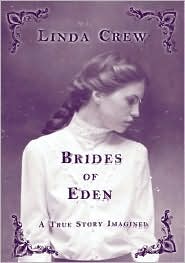
Review: Brides of Eden - Linda Crew

Synopsis: When, in 1903, the fiery preacher Joshua arrives in sleepy Corvallis, Oregon, Eva Mae - and the whole town - is never the same again. Joshua is wonderful. He's charismatic. Insisting on simplicity, he commands his converts to burn their possessions. Demanding devotion to Christ, he tells them to abandon their personal ties.

But there's a surge of violence rising, and before it's over, families will be ripped apart and lives will be destroyed. Eva Mae's gripping true story is a stranger-than-fiction tale of a turn-of-the-century apocalyptic cult.

Review: A thoroughly fascinating story, made only more so by the fact that it is true. It also struck my particular fancy because I have actually visited many of the towns mentioned within, and I had no idea that such an incredible, thoroughly creepy incident happened in Corvallis and around Yahats and other neighboring towns. And Linda Crew is an author whose research can generally be trusted.

What was probably most disturbing about Brides of Eden was that there are still people - Christians included - who allow crazy individuals like Joshua move their emotions into a frenzy, making all logical thought almost impossible. Such events are not just confined to the spiritualism of the 1800s.

There is very little content to be addressed. There is one bedroom scene, when Joshua informs the women that one of them will give birth to the Second Christ, and he requests to see each woman alone in his private shelter. It is necessary to events, and the Author handles the scene with kind delicacy. Also, there are 2 g--damns, and other references to Joshua having affairs with married women. But nothing explicit.

Brides of Eden is a book which will disturb Readers because it is a true story, but it is really interesting and is a highly recommended historical-fiction read.


Overall Rating: 
{{{{

Sunday, October 2, 2011

Review: Cleopatra's Moon - Vicky Alvear Shecter

Synopsis: Cleopatra Selene is the only daughter of the brilliant Queen Cleopatra of Egypt and General Marcus Antonius of Rome. She's grown up with jewels on her arms, servants at her feet, and all the pleasures of a palace at her command, and she wants only to follow in her mother's footsteps and become a great and powerful queen. Then the Roman ruler Octavianus, who has always wanted Egypt's wealth, launches a war that destroys all Selene has ever known. Taken to live in Octavianus's palace in Rome, she vows to defeat him and reclaim her kingdom at all costs. Yet even as she gathers support for her return, Selene finds herself torn between two young men and two different paths to power.

Review: A beautifully-written tale, Cleopatra's Moon seemed to promise a stirring historical adventure of intrigue, power struggles, and murders in the night. And it had all of that - and more. It is the "more" part which bothered me. Looking on the surface, this book was good. Cleopatra Selene, though inept at practically all that she attempted, was not the worst heroine to have, and her brother Ptolemy absolutely adorable. The descriptions of Alexandria were rich and vivid - so much so that the Reader could almost feel the warm, spiced wind and the blessed cool of palm trees.

But then you look deeper - or, rather, you read further into the book. While the Author did a splendid job with research, there is a rather unnecessary scene that seems to only serve the purpose of painting the Jews as, well, idiots who cannot even explain the depth of their beliefs (which is just ridiculous). They do not think like the Jews of the Ancient world, but like modern-day Evangelicals. It's painfully obvious that the Author spent more time looking up the Egyptian religion than Jewish beliefs, and I have to wonder why she even bothered putting the scene in at all.

Finally, there is the fact that the Author actually portrays the Romans too accurately. Yes, I am really voicing this as a complaint, and here is why: as I said, she portrays the Romans for what they were - a disgusting, perverted culture, whose economy was based solely on conquest. She also does a fairly good job of portraying the Egyptians the same way, but still manages to glorify them by picturing Cleopatra, Marc Antony, and Julius Caesar as being "not that bad of people." Where she got that Julius Caesar was kind and merciful to his enemies, I will never know, because any small reading of historical accounts written by Ancient historians will reveal that Julius Caesar was one of the most disgusting individuals that ever lived.

Putting that "minor" flaw aside, let us return to her portrayal of the Romans. This is where the sexual content comes into play. I will say this: the Author never becomes explicit, but she doesn't soften it either. Twice Cleopatra Selene is almost raped, there are numerous references to whores, men liking young boys (or other men), too-close-to-explicit-for-comfort groping and kissing scenes (again, no one wants to read descriptions of French kissing), and then finally, we do have a bedroom scene which I did not fully read, but it looked close enough to explicit to be absolutely inappropriate (ch. 44, pg. 315-316). But surely this is nothing to be irritated over, because it's an "interrupted bedroom scene," so that makes it okay (I am being sarcastic, by the way).

I realize that it is very hard to write a historical story containing Romans without mentioning their pervertedness, but it can be done tastefully, and even ignored to an extent. Rosemary Sutcliff managed to write tons of Roman-based books and never once found it necessary to delve as deeply into their disgusting habits as Vicky Shecter did.

In the end, we are left with a story that could have been excellent - well worth spending $18.00 on, in fact. But it's so populated with sexuality and immoral behavior (which, by the way, isn't necessarily painted as a bad thing; when Cleopatra Selene thinks her twin brother has a male lover, she thinks it's cute) that it makes it uncomfortable and practically impossible to read. I wish I had better things to say, but that is how it is.
Overall Rating: 
N

Friday, September 30, 2011

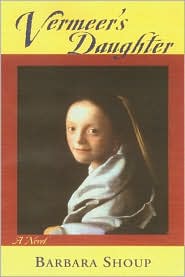
Review: Vermeer's Daughter - Barbara Shoup

Synopsis: Willful, dreamy, not-beautiful Carelina Vermeer is a trial to her wealthy Grandmother Thins, whose efforts to make her into a proper young lady are a constant source of tension in a large, loving, but quarrelsome family. Then, early one summer morning, she follows her father to a house on the harbor where he is preparing to paint his masterpiece, View of Delft, and her real life begins.

Barbara Shoup presents an interesting way of viewing Vermeer's life: through the eyes of one of his daughters, who is herself an artist at heart. Though this is entirely a work of fiction, it still brings to life one of the most famous painters in history, and the Reader is left feeling like they actually know Vermeer.

Review: Beautifully written, Vermeer's Daughter is an intriguing novel which focuses on some of Vermeer's most famous works. The mammoth-load of Dutch names can make it difficult to get through (there is, unfortunately, no pronunciation key in the back), but once you have worked that out to a satisfactory degree, the story is easy to become immersed in. It is a very fast read, being only 160 pages long, but it is a story which all ages would enjoy.

Overall Rating: 
JJJ

Tuesday, September 27, 2011

Review: Macaroni Boy - Katherine Ayres

Synopsis: Mike Costas has lived his whole life in the Strip, Pittsburgh's warehouse district. His father and uncles run Costa Brothers Fine Foods, and Mike is proud to lend a hand in the family business, which helps feed the city. But it's 1933, and the Depression is bringing tough times to everyone. Even worse, Mike's beloved grandfather has been growing forgetful and confused. Things at school are going downhill, too. Mike is being tormented by a bully named Andy Simms, who calls him Macaroni Boy. When dead rats start appearing on the streets, that name changes to Rat Boy. Mike isn't afraid to use his fists, but first he's got to watch out for Grandpap. Now the old man isn't just forgetting things - he's getting physically sick. Can whatever is killing the rats be hurting Grandpap?

Review: Macaroni Boy is one of those books which does have a storyline, but spends most of its time covering day-to-day occurrences, and whose storyline is a pretty small instance in somebody's life. A lot of this book talks about Mike's school troubles, his family's financial troubles (which is a theme that cannot be ignored in a Great Depression-era novel), and other such things. The storyline itself takes a little while to appear, and when it finally comes around, you are not certain if it's the storyline or just some other unlucky incident in Mike's life.

However, as far as these types of books go, Macaroni Boy is good, due to the time period, the writing style, and the fact that the Author chooses an interesting topic to build her plot around, so once the Reader gets to it, they'll be interested enough to finish it. The Author does a good job of covering the gross parts without so much detail that it will put Readers off of their breakfast (unless the Reader happens to be eating bananas). And she gives the family members personalities that don't grate on your nerves, like most family-member characters do.

All in all, Macaroni Boy is a book that a lot of younger Readers would enjoy.

Overall Rating: 
JJJ

Saturday, September 17, 2011

Review: The Diamond Secret - Suzanne Weyn

Synopsis: Nadya is a mischievous kitchen girl in a Russian tavern. Having nearly drowned in the Iset River during the turmoil of the Bolshevik Revolution, she has no memory of her past and longs for the life she cannot remember. Then two young men arrive at the tavern and announce that Nadya's long-lost grandmother has sent them to find her. Yearning for family and friendship, she agrees to accompany them to Paris for the joyful reunion. Nadya eagerly embarks on her journey, never dreaming it will be one of laughter, love - and betrayal.

Review: I am a great fan of the theories surrounding Anastasia's survival (even if modern historians insist that it was impossible for her to have survived), and The Diamond Secret presents a new and thoroughly interesting version of this "what if" scenario. It is, of course, a predictable story, but still enjoyable, and the ending had a small, surprising element that I was not entirely expecting.

Nadya is a very likable heroine, at times slightly annoying, but no one is perfect, and the two young men equally good, though sometimes the "leading man" was aggravating and I had a hard time entirely understanding why Nadya liked him.

Some of the dialogue feels off, but the writing style, as a whole, is pleasing and contains just the right amount of descriptiveness; Readers will be swept away by the beautiful imagery. The Diamond Secret is just as enjoyable as all other installments in this series.

Overall Rating: 
JJJ

Others in the Once Upon A Time Series:
The Storyteller's Daughter (Cameron Dokey)
Beauty Sleep (Cameron Dokey)
Snow (Tracy Lynn)
Midnight Pearls (Debbie Viguie)
Scarlet Moon (Debbie Viguie)
Sunlight and Shadow (Cameron Dokey)
Spirited (Nancy Holder)
The Night Dance (Suzanne Weyn)
Golden (Cameron Dokey)
Water Song (Suzanne Weyn)
Before Midnight (Cameron Dokey)
The Rose Bride (Nancy Holder)
The Crimson Thread (Suzanne Weyn)
Belle (Cameron Dokey)
Wild Orchid (Cameron Dokey)
The Diamond Secret (Suzanne Weyn)
Winter's Child (Cameron Dokey)
Violet Eyes (Debbie Viguie)
The World Above (Cameron Dokey)

Wednesday, September 7, 2011

Review: The King's Shadow - Elizabeth Alder

Synopsis: Evyn, a young Welsh serf, has dreamed all his life of becoming a storyteller. Blessed with a beautiful voice, he loves holding an audience captive with his words, reciting verses that have been passed down from generation to generation.

But in a cruel twist of fate, Evyn and his father suffer a brutal attack by a group of murderous ruffians. Evyn's tongue is cut off, and his father is killed. Because he is orphaned an unable to speak, most assume Evyn is destined to a life of slavery. But Evyn is resilient and teaches himself to read and write. Having mastered these skills, he is appointed the personal companion to Earl Harold of Wessex, who later becomes the King of England. The two travel the countryside together, forming a close father-son bond. Evyn chronicles all their exciting journeys, which culminate at the Battle of Hastings, where the future of the country is decided.

Review: This was almost worthy of Rosemary Sutcliff, in both story and writing. The Author's style does a wonderful job in capturing the love of the Briton countryside and heritage, as well as weaving historical fact and fiction together superbly. Her battle scene was well written, unlike so many modern stories. She did not focus on the fighting as individual scenes, like a movie does, but as a whole, and yet she does not neglect relating certain events through Evyn's eyes. Her storm-at-sea, too, was related masterfully, being blessedly short, but exciting and never dragging at the same time.

Normally, I do not like it when a main character is mute, but Elizabeth Alder managed it extremely well. The King's Shadow has very little dialogue the way it is, reading instead more like a narrative (almost like one of G. A. Henty's stories) so Evyn's muteness fit in perfectly, enduring his character further and developing his personality in a way that talking could not. By the end of the book, I was thoroughly attached to him and silently begged those printed words that he wouldn't die. The Author makes her other characters just as easy to attach oneself to, from the graceful and kind Lady Ealdgyth, to the curious and lively Brother Lewys, and even King Harold himself.

I absolutely loved this book as much as I love Sutcliff's books, and I hope to add it to my collection very soon.

Overall Rating: 
|||||

Tuesday, September 6, 2011

Review: Crusade - John Wilson

Synopsis: "Kill them all. God will know His own."

This was what the crusading knights of the Catholic Church were told as they stormed the walls of the heretic city of Beziers in 1209. Ten thousand people died that day - the first casualties of the only crusade fought on French soil.

Caught up in the horror are two childhood friends. Peter - an assistant to the mysterious priest who leads the crusade - is convinced that the war against the Cathars is God's will, a mission that will lead him to the highest ranks of power in Rome itself. John is far less certain about the Church's goals, and his doubts deepen when an intriguing Cathar woman helps him escape the burning city. As the pair travel together to a safe haven, John listens and learns and is soon embroiled in a dangerous mystery. As the brutal war against the Cathars expands and the flames of the Inquisition spread, Peter and John find themselves on opposite sides of the search for a secret that has the power to change the world.

Review: Crusade was certainly interesting, and the writing is good. John is easily liked, but the introduction to him and Peter feels like the Reader is dropped right in the middle of things, making Peter seem nothing but hard and completely unfeeling. I had a hard time feeling any connection to him; if the Author wanted the Reader to understand John's disappointment at Peter's new solemnness, he ought to have began the story a little earlier in their lives, so the Reader could see some of the change in Peter's character. As it is, it seems that Peter has always been like that.

The story also seems to be pretty one-sided. It portrays the Catholics as being nothing but horrible, while the Cathars are completely peaceful. After reading The Perfect Fire Trilogy, which presents a very balanced view of both religions (showing the good and bad of both), this did nothing but irritate me, and I had a hard time enjoying the story because of it. I hope that the Author doesn't do this in the second installment.


Overall Rating: KK

Others in The Heretic's Secret Series:
1)Crusade
2)Grail

Monday, September 5, 2011

Review: The Gnome's Eye - Anna Kerz

Synopsis: In the spring of 1954, Theresa's life changes forever. She and her family emigrate from a refugee camp in Austria to Toronto, Canada. Theresa's friend Martin gives her two gifts for her journey: a package of postcards and a stone he claims will protect her from all things evil, living or dead - a gnome's eye. When she finally arrives in Canada, Theresa is afraid of everything: the other tenants in the rooming house, the rat that lives in the sunroom, learning a new language, speaking in class. But as time goes by, her natural curiosity and her active imagination help her overcome her fears - even in the middle of a hurricane.

Review: An interesting "lifetime" story that, if you are looking for a quick read, would be a good choice. I admit that I was hoping it would have more of a storyline when I first picked it up, but I was not surprised to discover that it was one of those books that just follows the life of the character without anything really happening. If it wasn't for the time period, it would have been nothing more than a feel-good book about how to face one's fears. However, Theresa is a very good narrator and likable character, despite all of her fears and how easily she is angered. I did not like her at first, but she quickly grew on me. And I was not crazy about the writing style at first, but after a time, I found it to be all right, even though it began and ended very abruptly.

The Gnome's Eye will eventually find itself on my shelves.

Overall Rating: 
JJJ

Sunday, September 4, 2011

Review: The Betrayal of Maggie Blair - Elizabeth Laird

Synopsis: In 17th-century Scotland, everyone knows the devil is real. Everyone knows that witches exist. Everyone knows that saying the wrong thing can get you hanged . . . When Maggie's grandmother is accused of witchcraft, the sixteen-year-old has to run for her life. With English soldiers on the march, nowhere is safe - certainly not Ladymuir, where her uncle is determined to defy the king. And wherever Maggie goes, disaster follows. When an old enemy turns up at Ladymuir and settles in as one of the family, Maggie knows that trouble will result, but even she can't imagine the deceit and betrayal that's to come . . .

Review: A beautifully written and intriguing story that anyone would enjoy. I certainly did. Maggie is a strong, practical-minded young woman who conquers her fears as best she can and really tries to do her all at whatever task is set before her. She is independent without developing The Attitude that so many female characters have in today's literature. The villains are easy to dislike, and the nice characters easy to like. The most frustrating element to this story is how readily Maggie's relatives don't believe her when the "old enemy" shows up with a contradicting story. I could not help but exclaim out loud, "Are you really that dense?!"


Content is very light. There are some sexual alludements, but they are not at all detailed, and are brief. The writing style is not spectacular, but it is good in its simplicity, conjuring up beautiful images of the Highlands and downs, and of how rough life was. The Author presents the Reader with a fairly balanced view of Covanenters (Presbyterians) and Catholics, showing that not all Catholics were horrible people, and not all Presbyterians were peaceful.


I thoroughly enjoyed The Betrayal of Maggie Blair, and intend adding it to my collection.


Overall Rating: 
{{{{

Monday, August 29, 2011

Review: The Musician's Daughter - Susanne Dunlap

Synopsis: When her father is discovered dead in Christmas Eve, his valuable violin missing and a mysterious golden pendant found around his neck, fifteen-year-old Theresa is convinced murder is afoot. The key to her father's death seems to lie in his world of music, so Theresa sets to work as a copyist for acclaimed composer Franz Joseph Haydn.

Determined to uncover the mystery of his untimely end, Theresa gains access to the imperial halls of Prince Nicholas Esterhazy's court and delves into her father's secret life. The trail of blackmail and extortion she discovers leads her from the splendor of the royal court to the shadowy tents of a Gypsy camp. But it is the stirring love for a man she only thought she knew that might prove the most astonishing discovery of all.

Review: This was, by far, my favorite Susanne Dunlap book. It is an intriguing mystery with wonderful characters (especially Zoltan and his sister), fun references to historical people (Salieri, Mozart, Haydn, ect.), and even a likable romance which does not get in the way of the story! The Author's love for music rings clear in the writing, even making someone who isn't a musician or doesn't care for classical music feel Theresa's longing to be able to play the violin.

The content is very light, especially considering the Author's two other novels. There are slight references to rapes, a hint at one of the less important characters having a fancy for young boys, and one scene where Theresa is assaulted, but the latter goes nowhere, and the other things are not referred to in detail, and only mentioned in passing. The romantic element of the story is actually very pleasant, and once I was assured that it would not in any way impede the story's progress, I was fully supportive of the relationship.

The mystery, as I mentioned earlier, is highly intriguing and surprising. It is not necessarily filled with twists and turns, but it wasn't what I was expecting, and with the backdrop of Gypsies, court balls, the life of court musicians, and ancient instruments, this is a mystery that will keep anyone engaged.

Overall Rating: 
{{{{

Review: Seer of Shadows - Avi

Synopsis: New York, 1872. Horace Carpetine has been raised to believe in science and rationality. So as apprentice to Enoch Middleditch, a society photographer, he thinks of his trade as a scientific art. But when wealthy society matron Mrs. Frederick Von Macht orders a photographic portrait, strange things begin to happen.


Horace's first real photographs reveal a frightful likeness: it's the image of the Von Macht's dead daughter, Eleanora.


Pegg, the Von Machts' black servant girl, then leads him to the truth about who Eleanora really was and how she actually died. Joined in friendship, Pegg and Horace soon realize that his photographs are evoking both Eleanora's image and her ghost. Eleanora returns, a vengeful wraith intent on punishing those who abused her.


Review: I am not a great fan of supernatural stories simply because I like things to make sense, but I am a great fan of Avi, and I am a great fan of the Victorian era. Seer of Shadows was definitely one of the best ghost stories I have read in a long time. Avi presents his Readers with brilliant, complex characters that have very distinguishable traits, and while he works with a very small cast, he pulls it off extremely well without making the Reader wish that there were a few more new people.


The story itself is, for lack of a better word, awesome. I got creeped out reading it on a sunny day! The pace is fast, but not so fast that the Reader feels like the story is running them over. The Author keeps things moving at an agreeable rate, ending each chapter on cliffhangers that actually work, and didn't make me roll my eyes and say, "Oh, well that's not typical." The Reader is also presented with historical and technical descriptions of photographical processes which manage to not bog the story down, but adds to the overall rich background of this novel.


Seer of Shadows is absolutely brilliant, and could have only been told by a truly masterful storyteller like Avi.

Overall Rating: 
{{{{

Saturday, August 27, 2011

Review: Anastasia's Secret - Susanne Dunlap

Synopsis: For Anastasia Romanov, life as the privileged daughter of Russia's last tsar is about to be torn apart by the bloodshed of revolution. Ousted from the imperial palace when the Bolsheviks seize control of the government, Anastasia and her family are exiled to Siberia. Yet even while the rebels debate the family's future with agonizing slowness, and while the threat to their lives grows more menacing, romance quietly blooms between Anastasia and Sasha, a sympathetic young guard she has known since childhood. But will the strength of a love that exists in secret be enough to save Anastasia from a tragic fate?

Review: I am having trouble, even now, after several weeks since reading this book, in formulating my thoughts about this story. On the one hand, it is very interesting - what book isn't, when it concerns Anastasia Romanov? But on the other hand, it was massively disappointing. The majority of the first half is good - Susanne Dunlap presents the Reader with her usual rich descriptions and complex characters. But I quickly became frustrated with Anastasia's lack of political knowledge (though this is probably not an entirely inaccurate portrayal), and Sasha, her love interest, goes from a pleasant sort of fellow to downright vexing. His contempt for Anastasia's ignorance and always calling her a child is irritating, because he does nothing to enlighten her on what is going on, and then getting mad at her when she expresses her ignorance.

Content quickly spirals downhill from there, when the Author begins to describe French kissing in pretty thorough detail, characters grope each other, and then there is finally a bed scene in Chapter 21, page 203. While it is not horribly detailed, it is suggestive enough of what is happening to make it wildly inappropriate, and I actually found it rather disrespectful towards Anastasia's memory to have her sleep with someone. Thankfully, however, the Reader can avoid the majority of these nasty details - skip the parts where Sasha and Anastasia meet up, and enjoy the rest of the book, because all other occurrences in the story are interesting.

It is unfortunate that the Author put in so much lustfulness; Anastasia's Secret could have been both a good wartime novel and a good love story, were it not so bogged down with physical pleasure. When I think back on this book, I can only think disappointing thoughts.


Overall Rating: 
KK

Friday, August 5, 2011

Review: The Twin's Daughter - Lauren Baratz-Logsted

Synopsis: Lucy Sexton is stunned when a disheveled woman appears at the door one day . . . a woman who bears an uncanny resemblance to her own beautiful mother. The two women are identical twins, separated at birth and raised in dramatically different circumstances: one as a member of high society, the other in a workhouse. Lucy's mother quickly resolves to give her sister the kind of life that she had never known, and the transformation in Aunt Helen is remarkable. As time goes by, Lucy herself transforms into a young woman, falling in love with a childhood friend she was once sure she hated. But in what should be a happy household, something is very, very wrong. And as Aunt Helen and Lucy's mother become ever more indistinguishable, Lucy begins to suspect that her aunt's now familiar face may mask a chilling agenda.

Review: This story had a lot of potential for being one of the best stories of mistaken identity and revenge I have ever read. The Author keeps things moving very well from the very beginning, dropping hints to a future twist that the Reader will not forget. Lucy is a witty, but proper, narrator who won't allow her Readers to miss out on the action. But here is where the good factors end.

Enter Kit (Christopher) Tyler, the main young man. I was dubious about the romance in this story from the beginning - I always am, just to be on the safe side. But I liked Kit; he was a very nice, honest boy. So I didn't understand why Lucy was such a jerk to him. It's like the Author wanted to have the whole modern trend of "heroine thinks she hates hero, treats him like garbage, then falls in love with him," but was conscious halfway through that such behavior did not suit Lucy's personality at all (it was really out of place), so rather than just rewriting it, she decided that Lucy gets over her sauciness very quickly and becomes fast friends with Kit. All this does is make Lucy seem bipolar.

Things progress downhill rapidly from there. The Author continues to maintain the suspense, and I spent the whole time thinking, Any minute now, things are going to be unveiled. Well, things are unveiled all right - far more things than need be, and not the sort of things that I was expecting. Let us start with female puberty, shall we? I am not a great advocate for putting such private, though natural, details in a story. No female wants to read a detailed account of a character going through female changes, and no male should know about it - and they certainly shouldn't learn about it from a book. Sometimes such things must be touched upon, but the Author of The Twin's Daughter did more than just touch upon it, all the while attempting to write it in delicate words, but there comes a point where one goes into so much detail that no amount of polite phraseology is going to rescue it.

Next up is the sexual content. For the most part, this remains in the "reference only" category, where things are alluded to when talking about certain people, and that is about it, with the exception of kissing scenes that start to progress into a little too much intimate touching and "mysterious" noises emitting from bedrooms. But in Chapter 42, page 366-369 we have an actual bedroom scene that is not horribly explicit, but comes so close to being thus that it's a wonder the Author didn't go into full-fledged descriptions. The only positive thing I can say about this absolutely unnecessary - and very private - scene is that at least the characters were married. But that gave me very little comfort, because books just should not include such intimate scenes even between married couples. Some things need to be left behind doors and not shared with the public, even in fiction. Leave it to the Reader to conclude that marriage usually leads to the sort of wonderful love that produces children, and don't literally spell it out.

Finally, the twist is revealed - and it is not at all what I was expecting. And I don't mean that in a good way. It reminded me of a perfect plot for a soap opera, actually, and in the end the characters are either completely immoral or go through a complete change of personality as to leave the Reader feeling like the only thing they can side with is that poor houseplant in the corner which has had to witness everything right along with you.

The Twin's Daughter could have been so good, but in the end, it is just one big letdown with way too many intimate moments that no one should have to read.

Overall Rating: 
N

Thursday, August 4, 2011

Review: In the Shadow of the Lamp - Susanne Dunlap

Synopsis: It's 1854, and Molly would give anything to change her circumstances as a lowly servant in a posh London house. So when she hears of an opportunity to join Florence Nightingale and her nurses in the Crimea, the promise of a new start - and perhaps even adventure - is too tempting to pass up.

The work is grueling, the hospital conditions are deplorable, and Miss Nightingale proves to be a demanding leader. But before long, tending to sick and wounded British soldiers becomes more than just a mission of mercy; it becomes a mission of the heart when Molly finds that she's falling love with not one, but two young men. With the battle raging ever nearer, one of the men will fall victim to the great guns. Will it be the dashing young doctor who sees Molly as more than just one of Nightingale's nurses, or the foot soldier who has left everything behind and joined the army to be near to her?

Review: I was, at first, uncertain whether or not this would be a good story with the "duel romance" element thrown in for good measure. In my experience, such details are only irksome and end up making the Reader hate everyone, and finally attaching themselves to That Guy because said Reader is fed up with everyone else.

The romance isn't as annoying as I was anticipating, but it wasn't my favorite. For once, however, I actually had nothing against the two men Molly Fraser finds herself mixed up with - Will Parker and Dr. Maclean. They were fine. Will was honest and gentle and clearly cared for Molly deeply, while Dr. Maclean cared for his patients and tried to do his best at his job. And while, for the most part, I liked Molly as a heroine, her indecision between the two got a bit on my nerves. Though both good young men, the infatuation between her and Dr. Maclean seemed rather sudden, while the relationship between her and Will felt right, and there was something just slightly off about Dr. Maclean that had me totally rooting for Will Parker. I saw it so clearly that I wanted to scream at Molly (and quite nearly did, but was reading in a public area and thought that maybe it would scare a few people if I yelled at the book), and towards the end of the book, I started to think her as a bit selfish for pushing aside Will's affections so many times because she liked the "danger" feeling she got around Dr. Maclean rather than the "safe" she felt around her friend.

However, this does not get in the way of the overall good storyline too much, and if I were not inclined to like both Dr. Maclean and Will, as well as Molly, I would say that it didn't belong. But it does because all three really are likable characters, and the Author wraps up the "love struggle" neatly and satisfactorily (managing to make it sad, but happy at the same time) in the end.

The writing is good, though not spectacular (I mean this as a compliment. Few authors' writing styles are spectacular; good is a thing to be proud up in a world where hardly anyone can write anymore). The Author conveys clearly the nitty-gritty of the hospital in the Crimea and the gristliness of the work therein, but without unnecessary details. I was able to munch on a molasses cookie easily enough while reading some of the meatier bits without my stomach flipping. Her historical detail is rich and accurate, though she takes a few acceptable liberties. While I knew quite a bit more about Florence Nightingale and the Crimean War before reading In the Shadow of the Lamp than most people, I find myself far more curious about it now, and intend to do some deeper research.

This book comes very recommended.

Overall Rating: 
{{{{

Friday, July 29, 2011

Review: Wrapped - Jennifer Bradbury

Synopsis: Agnes Wilkins is standing in front of an Egyptian mummy, about to make the first cut into the wrappings, about to unlock an ancient (and not-so-ancient) history.

Maybe you think this girl is wearing a pith helmet with antique dust swirling around her. Maybe you think she is a young Egyptologist who has arrived in Cairo on camelback.

Maybe she would like to think that, too. Agnes Wilkins dreams of adventures that reach beyond the garden walls, but reality for a seventeen-year-old debutante in 1815 London does not allow for camels - or dust, even. No, Agnes can only see a mummy when she is wearing a new silk gown and standing on the verdant lawns of Lord Showalter's estate, with chaperones fussing about and strolling sitar players straining to create an exotic "atmosphere" for the first party of the season. An unwrapping.

This is the start of it all, Agnes's debut season, the pretty girl parade that offers only ever-shrinking options: home, husband, and high society. It's also the start of something else, because the mummy Agnes unwraps isn't just a mummy. It's a host for a secret that could unravel a new destiny - unleashing mystery, an international intrigue, and possibly a curse in the bargain.

Review: While Wrapped certainly has allusions to the supernatural (mummy curses, ancient artifacts with power, ect.) and magical, no otherworldly powers come into play, which surprised me a little. When I first read a synopsis, my first thought was, Oh, this ought to be very strange indeed, and while it is a bit strange in its own way, it is a good strange. I thoroughly enjoyed this book, even if the villains were a bit too obvious and some of the dialogue was less than pleasing. Agnes is a very strong, adventurous character whose thoughts and opinions seem properly suited for the sort of "modern" thoughts a girl her age would have had in 1815. In other words, she's not too much ahead of her time. The Author's constant alludements to Jane Austen (A Lady) and her novels will please any Austeneer, as well as lending a more historical feel to the setting (so few historical fiction stories mention the literature of the explored era).

The ending was both predictable, a little cliche, and surprising, leaving room for possible sequels if ever the Author decides to do so. At the same time, though, Wrapped doesn't need any, but I would not protest if there were. Agnes's romantic inclinations towards Caedmon is not vexing like so many "young romances" are in modern literature, and I would enjoy seeing it develop further.

And of course, the backdrop of the Napoleonic War, spies, and Ancient Egypt add much flavor, while making it thoroughly unique to many other historical-set spy stories. Napoleon's fascination with Egyptology is not a subject often explored, nor is the archeological discoveries made during that time, though as the Author points out in her Afterward, "unwrapping" parties (where mummies were unwrapped by party guests for entertainment) were more in vogue in later years. However, it's an acceptable liberty, and makes for a very interesting - and unique - way of introducing the wonderfully engaging events that Agnes and Caedmon soon find themselves "wrapped" up in.

Good job, Jennifer Bradbury!

Overall Rating: 
{{{{

Saturday, June 18, 2011

Review: Alchemy and Meggy Swann - Karen Cushman

Synopsis: "Ye toads and vipers!" Thus says Meggy Swann, newly come to London from the country village where she was raised. She's not happy to be there, and why should she be? Her mother was glad to see the back of her. Her father, who sent for her, doesn't want her after all. The city is awash in dirt and muck, teeming with thieves and rogues, and very wearying to walk around in - especially for Meggy. She is the alchemist's daughter, though. Just as her father seeks to transform base metal into gold, Meggy sets out to change her condition for the better. In doing so, she finds herself to be braver and stronger and friendlier than she ever thought possible, and a competent rhymer as well.

Review: I absolutely love Karen Cushman's stories, even though she sometimes likes to go into detail about the lack of hygiene in the Renaissance a bit too much at times. And Alchemy and Meggy Swann has to be one of her best, if not the best. Meggy is a girl who, no matter the situation, lands on her feet and will fight her way to survival. She has a sharp tongue, but that sharp tongue keeps her alive and she is genuinely witty.

The dialogue, too, is wonderfully authentic without being just impossible to read. And the Author writes of the horrors and filth of Elizabethan London streets in such a matter-of-fact manner as to render it humorous, actually rather reminding me of Charles Dickens.

Alchemy and Meggy Swann comes highly recommended for all ages. It's a very quick and enjoyable read that anyone would like.


Overall Rating: 
|||||