 The Wheel of Time turns, and Ages come and go. What was, what will be, what is, may yet fall under the Shadow. Let the Dragon ride again on the winds of time.
Not even the person in charge of writing synopsis which are found on the inside flap of a hardcover book (or on the back of a softcover, in this case) could come up with a proper summary of Robert Jordan's acclaimed masterpiece. If they did, for some reason they contrived to not put it on the back of the copy I borrowed from the library. Perhaps the Summary Writer started writing one, realized that anyone who took a half-second of a glance at it would immediately put it back, and decided, The more vague it sounds, the more readers will succumb to sheer bloody curiosity.
Well, I didn't exactly succumb to curiosity. No, unfortunately I knew exactly what I was plunging into when I picked up the first book in The Wheel of Time series. Or, at least, I thought I knew. My sister told me that I had to read at least the first book, laughing gleefully to herself. What she didn't tell me was that The Eye of the World would be a truly religious experience. . .
That is, if your religion consists of making yourself suffer as horribly as is possible. Wait! I believe Buddhism does that! Robert Jordan's series would be more appropriately named The Wheel of Suffering, not The Wheel of Time. Well, it was certainly my own little Wheel of Suffering. Though I did not finish The Eye of the World, what little I got through should ensure enlightenment for quite some time. I started reading the book with the intention of finishing it - I really did! But . . . then I looked at the Index. Then I counted the pages. And then . . . I read Chapter 1. Brisingr was easier simply because it is Young Adult fiction. This is Adult Fiction! Written by an adult! One is supposed to be waaay past this.
The Eye of the World starts with a farmboy. Surprising, right? I mean, what fantasy novel doesn't have a happy, clean, well-fed, well-spoken, educated, adolescent male suffering from a severe lack of . . . Well, everything. Now, Robert Jordan couldn't use hobbits and elves and wizards and dwarfs - oh no. But he managed to rack up . . . Oh, three very annoying adolescent farmboys (Rand, Mat, and Perrin), two men-hating women (Egwene and Nynaeve), a not-quite-a-wizard-but-knows-old-legends-and-smokes-and-has-a-white-beard dude (Thom, the gleeman), a lump who does all of the heavy work (Lan), and a female wizard lady with a glowing stick that doesn't really do anything useful until MUCH later (then the Reader and characters discover all of these nifty things it can do; things that would have solved a boatload of troubles earlier), and who hands out coins as tokens that you're not supposed to spend, but then she gets mad when you do spend it (Moiraine). Oh, yes, and later another flirtatious girl is added to the deck (Min), along with someone else and then another character who I'll get to later.
With such a large slew of characters, you would think that finding a single likable one would be fairly easy. I am laughing evilly right now, for I know most of you are thinking, Isn't there one? Well, let me put it this way: Rand is the typical fantasy farmboy - clueless, whiny, tries to be an influence to the kiddies, pretends that he isn't oogling at the passing ladies, struts around with a puffed-out chest, and shmooshes every inn's cook. Oh, yes, and of course he has a mysterious destiny that he has to come to odds with.
Mat, though, must be the most annoying out of the three. He is the "prankster," but never have I encountered a more irritating one who expresses his excitement with the most aggravating and redundant exclamations. He is also the stupidest out of the group. Example: at one point the octet of travelers are being chased by uggubuggus (i.e. monsters, or the badguy's "best soldiers") - a whole army of them. After Moiraine causes an earthquake and builds a wall of fire (something she could have done earlier!), Lan the Lump comes up with the brilliant idea of hiding out in "the one place that the Trollocs will not go." (i.e. the Trollocs are the uggubuggus.) It's a city. An abandoned city with a creepy, ominous name of Shadar Logoth. Now, this is a place that everyone would like to avoid, and our octet could've avoided it at all costs - or no cost at all. But, no, instead they decide to camp there. Mat, Rand, and Perrin go exploring. At night. They encounter a weird suspicious-acting old man by the creepy dark name of Mordeth. They follow this creepy dark fellow of the creepy dark name of Mordeth into a creepy dark staircase into a creepy dark room with lots of glittery treasure. Mordeth encourages them to take some. Through a series of not-so-complicated, but very-uninteresting events, the trio discovers that Mordeth is a dark spirit-type thingy. What a shocker. It is only after this that Moiraine informs the three stupids that, "Oh, this place is cursed and there's spirits that will kill you if you wander about at night, and by the way, there's this really bad spirit named Mordeth who will possess you if you accept any of the treasure." Talk about an FYI! Now, Mat did take something from the treasure - and after hearing this, he doesn't return it. This piece of the treasure is, of course, cursed, and it ends up, um "haunting" him later. Not only can I not believe the sheer stupidity of Mat in this escapade, but it also boggles my mind as to why this scene was even necessary. There was absolutely no reason they had to go into that city, and there is absolutely no reason why Moiraine didn't tell them earlier about the city's skeletons in the closet.
Perrin is the least annoying out of the three, but he's still pretty vexing. The only thing that keeps him from being as annoying as Rand and Mat is the fact that he doesn't talk much. Something ends up befalling Perrin, too - I didn't exactly read that part, though I skimmed it. Let us just say that Perrin contracts yellow eyes (oddly enough, none of his friends seem worried by this), and he has a yearning for raw meat, hunting, and he starts growing a bit of gray hair in places that hair isn't supposed to grow on people. Next he'll be howling at the moon. No one knows why this happens - no one cares. Next there will be a vampire.
Lan. There is not much to say about Lan the Lump. He's . . . someone. Who does . . . something. Every once in a while, Lan the Lump spoke sense. When Egwene complained for tea, he snapped "No tea!" When Egwene joins the sextet (this is before it's an octet), he makes a wonderful observation that she will serve no use. Sometimes I liked Lan the Lump, but personally, a bush would have made more contributions as a main character.
The only good character was Loial. Sadly, Loial does not appear until much, MUCH later, and even he could not get me to read those last few chapters entirely. Loial is a quiet, bookish, shy, polite sort of character. He was out of place in the story, and I wish I could adopt him. But I can't. Not unless I wrote a story with Ogres. Yes, Loial is not a human, but an Ogre - or, rather Ogier, as Jordan thought he must spell it. It is sad, Readers, when the only completely-likable character is an Ogre. Shrek even had other characters that were more likable than the ogres.
And now that I have done my litany on characters, I will move on. I have heard from several fans and ex-fans who met Robert Jordan that he was a conceited jerk. I'm not surprised; it shows in his writing. Mr. Jordan clearly saw himself as a master storyteller. I have seen worse writing, but those authors have had the excuse of youth and inexperience on their side. In the 19 chapters (294 pages) that I read word-for-word, I encountered some of the most hilariously-bad phrases I have ever seen. These are the three main highlights:
"Stars gleamed like points of light" (pg. 146) [No comment.]
"Rand's heart shriveled like an old grape." (pg. 268) [Seeing that Rand is the main character, at this point the story should be over.]
"So this is what battle is like." (pg. 146) [Rand's most profound thought.]
On top of these three most brilliant phrases, Robert Jordan also seems to suffer from the Capitalization Bug. The Capitalization Bug is when an author randomly capitalizes words to stress that they are important, without explaining why they are important. Note: capitalizing a word does not make it important. My list of RCWs (Randomly Capitalized Words), at the end of 294 pages, was 64. What I read was not even half of the book. And none of those words in that 64 are counted twice. Jordan capitalized words like Traveled (that was our favorite), All, Power, Children, Spirit, Common (and not the commons of a town), Exile, Longing, Web, Sword That Cannot Be Touched, and various colors. Jordan also thinks that if he repeats a single word over and over enough times, people will become as excited over a scene as he did when he wrote it.
Then there's the random clubs. Clubs whose jobs, positions, political standings, and whatnot are not explained (clearly the Reader is supposed to magically know about them already). There's goodie clubs that turn out to be baddie clubs (at least, I think they were baddies), and then baddie clubs that turn out to be goodie clubs. And of course all of the clubs in between. Jordan has so many clubs that he runs out of names and starts to color-code them (no joke).
Lastly, there is the You Have to be Joking moment. It is . . . Moiraine's momentary growth spurt. I know that your head is cocking to one side and your eyes are bugged out in confusion at this point. That was my exact expression when I read this. Okay, so the setup: the octet is escaping a town - never mind which one - because some sightless maggoty fellow who is obviously just in search of directions has found them (and apparently he isn't supposed to). It is nighttime, so clearly the city gates are shut. Lan the Lump kindly asks that the gates be opened, they are, then one of the baddie clubs shows up and tries to stop them. Rather than making the baddie club-members momentarily freeze, or maybe cast five-minute blindness, Moiraine grows. As tall as the city walls - taller! She towers over the city, her eyes like twin moons (that is an almost-direct quote). One hopes that her clothes grow with her, though it is never specified. After everyone else has escaped through the now-open gate, Moiraine simply steps over the walls and continues on her merry way at her normal size. Do I really have to voice my personal reaction to this? I have read of a lot of stupid spells and whatnot, but that was special.
And before I close, I would just like to make a special note of someone who I marked as my hero in the story, even though he died as soon as he appeared. Narg the Trolloc was my absolute favorite. He clearly was attempting to assure Rand in the farmhouse (yes, Rand's farmhouse is attacked by uggubuggus; sound familiar?) that he was a friendly sort and hated to see little Rand scared. Poor Narg; he never saw the sword. Narg had more personality than a single one of the others, and I really think he ought to have be instated as the book's hero. Then maybe I would have read all of it.
And so I must close, Readers. If you are wishing to reach nirvana quickly, I suggest you read The Wheel of Time. You will experience so much suffering that your Wheel of Suffering will be ended. In fact, I don't know why more Buddhists don't read The Wheel of Time to reach enlightenment.
Cheers!
 Synopsis: The kingdom is in danger. Renegade knight Sir Keren has succeeded in overtaking Castle Macindaw and now is conspiring with the Scotti. The fate of Araluen rests in the hands of two young adventurers: the Ranger Will and his warrior friend, Horace. Yet for Will, the stakes are even higher. For inside Castle Macindaw, held hostage, is someone he loves.
Review: I liked this one better than The Sorcerer of the North. Despite the fact that Horace is present for all of it - and the Skandians, who were amusing when Halt was around, but just too . . . Vikingish otherwise. Be ready for the action to start immediately. The Siege of Macindaw picks up where The Sorcerer of the North leaves off. Things move at a good enough pace, the slower parts being lightened with Flanagan's typical jests between Horace and Will.
However, now I must criticize Mr. Flanagan. I really don't like to, because he is a nice fellow (I met him once at a book signing), but as a book critic - even an amateur one - I must point out pros and cons. And the con for this one is the same I have for The Battle for Skandia and The Burning Bridge: Flanagan is good at writing humor and good storylines, but he isn't cut out for battle sequences. Though Ranger's Apprentice is a fictional series, Flanagan did take some pains to do historical research of the time period that Araluan is based in - and also battle tactics (it is sad, though, that he didn't do more research on bows). Flanagan displays his research on sieges in various conversations between Will and Horace, and it is very interesting. But when it comes to writing actual battles - it is a muddle. Flanagan's writing is movie-ish, as I have said before, and when it comes to a battle, such writing style turns everything into a muddle. His technical side of descriptions logs things down, and giving perspectives from various characters is not a way a battle ought to be told. If one must write a battle, it ought to be done in an "aerial view" or as if a historian were relating it. Give formations and the whole, sometimes zoning in on specific areas when necessary.
This is harder to do than it sounds, and that's why I don't even try to write battles. And I am sorry to say that Flanagan suffers from the same difficulty in writing battle scenes that are not a muddle. And yes, I know - battles are muddles. But they shouldn't be a muddle to read. The battle in The Siege of Macindaw is easier to follow than the one in The Battle for Skandia because it is smaller in scale. But still a bit muddled.
All in all, I do look forward to reading the books that revert back to when Will is still Halt's apprentice. Book 5 and 6 were interesting and should definitely be read, but there is something still lacking in them. The thing lacking is Halt. Without Halt, Will takes on some of Halt's personality, and it doesn't quite work for such an easy-mannered, happy young man. Halt simply cannot be left out. I look forward to reading Erak's Ransom.
Star Rating: 3/5 (liked it)
Others in the Ranger's Apprentice Series:
1)The Ruins of Gorlan
2)The Burning Bridge
3)The Icebound Land
4)The Battle for Skandia
5)The Sorcerer of the North
6)The Siege of Macindaw
7)Erak's Ransom
8)The Kings of Clonmel
9)Halt's Peril
10)The Emperor of Nihon-Ja
11)The Lost Stories
 Synopsis: Several years have passed since the apprentice and his master, Will and Halt, led the Skandians to victory against invaders, and Will is finally a full-fledged Ranger with his own fief to look after. The fief seems sleepy - boring, even - until Lord Syron, master of a castle far in the north, is struck down by a mysterious illness. Joined by his friend Alyss, Will is suddenly thrown headfirst into an extraordinary adventure, investigating fears of sorcery and trying to determine who is loyal to Lord Syron . . . and who is planning to betray him. Will and Alyss must battle growing hysteria, traitors, and most of all, time. Lord Syron is fading, but when Alyss is taken hostage, Will is forced to make a desperate choice between loyalty to his mission and loyalty to his friend . . .
Review: I feel ashamed that I, a devoted bookworm and fan of the Ranger's Apprentice series, should have taken so long to get to Book 5. Especially when I was so excited about it. But even the best of us get distracted by life in general and other books that demand our attention. Despite the long delay, I have finally finished The Sorcerer of the North and intend to read The Siege of Macindaw in short order.
Before I begin my review, I want to inform you that The Ruins of Gorlan is my absolute favorite in this series. It always has been, and it always will be. The fact of the matter is I don't like Horace. Rather, I liked Horace in The Ruins of Gorlan because he was an ineffectual bully and it suited him so well. I didn't like it when John Flanagan made him and Will best friends, for now it meant that The Hulk (as I and my sister have dubbed him) would be almost everywhere that Will was. While it lent for some funny scenes in The Icebound Land, I don't agree that having a virtual wall as a main character is a good idea. So I was glad when I opened this book and found no Horace. Until the end, that is. Which means The Hulk is back in for The Siege of Macindaw. Sigh.
The Sorcerer of the North was not my favorite from the very start. Something struck me as off about the characters, and last night I finally pegged it: Will has taken on some of the characteristics of Halt. While this certainly would happen because Will has trained under Halt, it was more like the Author was trying to combine Halt and Will together, and the result was not very pleasing. Will is Will; Halt is Halt. The two personalities do not mix well in one person. And also, what short and few scenes Halt is in, he isn't acting himself. I realize that Halt is now older than in the previous four books, but there was still something that did not ring quite true to his character. His comments were almost childish and often completely unnecessary. Halt is not someone who would make unnecessary chatter. Also, the dialogue became much more modern in style. John Flanagan's dialogue has always been rather modern-styled, and his writing in general movie-ish. I excuse him this fault because he used to write for the television sitcom Hey Dad! But it really felt as if it were vamped up more in this one.
However, I don't want my Readers to get the impression that I disliked this book, because I didn't. The storyline was very intriguing and I didn't figure out who was to blame for the hauntings and whatnot until I was halfway through the book. (Of course, once I did, it was so obvious that I became frustrated with the characters for not figuring it out just as quickly. But I suppose that if they had, the book would not have been as long.) And I am immensely glad that Alyss replaces Evelyn/Princess Cassandra as the leading lady. I really liked Alyss. She is intelligent, resourceful, not at all afraid to get her hands dirty, but still retains a very sophisticated, elegant manner. She doesn't tote an attitude about, and while there is certainly flirting between her and Will (inevitable, that), she is not obnoxiously mushy around him at all. When she is working, her mind is completely on the job at hand. And she is able to have friendly talks with Will without it turning into mushy-mushies every bloody time. Most importantly - and what makes her so much better than Evelyn - Alyss is useful and does not whine.
I am glad that I have The Siege of Macindaw to read directly after this one; the two are most certainly connected. Book 5 - The Sorcerer of the North isn't as good as the first 4 - I wasn't expecting it to be, - but it was still very enjoyable and the storyline quite engaging. Fans of Halt will be sad that he isn't in it much, but fans of Tug (like me!) will be pleased that Will isn't forced to travel without his clever little pony, but takes him along.
Like all of Ranger's Apprentice, this one comes highly recommended - just don't expect it to be as good as the first four.
Star Rating: 2/5 (it was ok)
Others in the Ranger's Apprentice Series:
1)The Ruins of Gorlan
2)The Burning Bridge
3)The Icebound Land
4)The Battle for Skandia
5)The Sorcerer of the North
6)The Siege of Macindaw
7)Erak's Ransom
8)The Kings of Clonmel
9)Halt's Peril
10)The Emperor of Nihon-Ja
11)The Lost Stories
 Rated: PG
I will skip a synopsis for this and "cut to the chase," as it were. After all, I am pretty certain that most everyone has a pretty good idea what it is about - and anyway, a synopsis would not be able to help you much.
Rated: PG
I will skip a synopsis for this and "cut to the chase," as it were. After all, I am pretty certain that most everyone has a pretty good idea what it is about - and anyway, a synopsis would not be able to help you much.
I will start off by saying that I did enjoy the third installment of The Chronicles of Narnia. It was not as good as The Lion, the Witch, and the Wardrobe or Prince Caspian, true. I wasn't expecting it to be. There was a new director, new composer, and a new company to replace Disney. Such new things usually make a sequel not as good as its predecessors. So since I did not go in with such high expectations as most seem to have, I was able to like it for what it was.
Part of what made this one not as good as the other two is the fact that there isn't much of a storyline. This is no fault of the producers - the book doesn't have much of a storyline, either, and the makers tried to fix this as much as they could. They probably could have done a better job than they did, but then Narnia purists would be complaining even louder than they already are. Given these factors, the director did his best.
But, honestly, could they not have done better with the ship itself? While very pretty visually, anyone who knows anything about ships will notice many things amiss. Things like untarred lines, flimsy blocks and clips that, were they on a real ship, would snap in a trice should any real strain be put on them. Yes, most people will not notice this - but I really cannot pardon the lack of tar on lines. Even an untrained eye would catch this; it is a fundamental aspect of a working vessel. The sea and the weather that accompanies it is hard on rope, wood, paint, etc. Tar protects.
This aspect was more painful for my sister than I, her being a scholar of ships and sailing in general. What amused me most were some points concerning . . . Caspian. Correct me if I am wrong, dear Readers, but did Caspian not have a decidedly Spanish accent in the second movie? I know, it was not his real accent; that he is British. That is obvious if you watch Voyage of the Dawn Treader. I don't know if the director decided that with the very long hair (longer than mine!) and sad little beginnings of a beard, Caspian would just seem too gay with a Spanish accent and chose to bag it altogether, or what. But Caspian is now British - and decidedly from London. I am sorry - absolutely everyone will notice that. And I could not stop cackling over it.
And so I must close my review. It is an enjoyable movie and was a great source of amusement for my sister and I. It is a good thing there were only two other people in the theater; we might have been thrown out if there were more to overhear our snickers and hilarious comments concerning Caspian's brilliant locks (and no, these were not comments in favor of). I will probably buy it when it comes out on DVD, but it is not necessarily one you have to see in theaters. Unless you simply must see it in 3D - which I didn't; 3D gives me a headache. And as enjoyable as this one was, I do hope The Silver Chair is better. I have hopes for that one, for it has more of a storyline than Voyage of the Dawn Treader.
 Forced to drop out of an esteemed East coast college after the sudden death of her parents, Jane Moore takes a nanny job at Thornfield Park, the estate of Nico Rathburn, a world-famous rock star on the brink of a huge comeback. Practical and independent, Jane reluctantly becomes entranced by her magnetic and brooding employer and finds herself in the midst of a forbidden romance.
But there's a mystery at Thornfield, and Jane's much-envied relationship with Nico is soon tested by an agonizing revelation from his past. Torn between her feelings for Nico and his fateful secret, Jane must decide: Does being true to herself mean giving up on true love?
This will be the first review I have written on a book that I have not finished. But I won't finish it - I don't need to. I dislike modern-set stories, but I was willing to try this one out because it was a contemporary version of the famous novel Jane Eyre, which I enjoyed. I was curious to see what April Lindner would do with it.
Four words: I was not impressed. While Jane Moore herself is, for the most part, a likable character and fairly close to Jane Eyre, Nico Rathburn is an entirely different story. I never liked Mr. Rochester from Jane Eyre, but my dislike for Nico Rathburn were for the simple reason that he was not at all like Mr. Rochester, and just basically annoying. However, the characters are the least disagreeable aspects of this book.
I got to Chapter 18 - so 209 pages into Jane. It is 365 pages long, 27 chapters. In that short span of words, I encountered 8 f-words and 5 s-words. I know there are few people who care about that, but I do, and for those of my Readers who are like-minded, you will understand my frustration and appreciate the warning. There was no need for the language - especially when the story is based off of Jane Eyre! But what made me close the book so firmly and set it on my "To Return To Library" shelf was the beginning of Chapter 18 - Jane and Nico sleep together. Whether they actually go through with this scene, I don't know, nor do I intend to find out. But what little I skimmed, it is explicit and it completely ruined the Author's claim of being a true Jane Eyre fan. No real fan of Charlotte Bronte's classic story would ever have Jane give into such immoral whims. In fact, in Jane Eyre, Jane outright refuses to live as Mr. Rochester's mistress.
So, for those of you who like Charlotte Bronte's Jane Eyre and were curious to read Jane - a contemporary version, - you will be disappointed. In modernizing it, April Lindner tainted the story with unnecessary language and sexual content that is completely out of the spirit of Jane Eyre.
Star Rating: 1/5 (didn't like it)

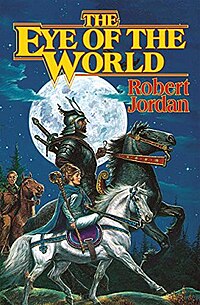 The Wheel of Time turns, and Ages come and go. What was, what will be, what is, may yet fall under the Shadow. Let the Dragon ride again on the winds of time.


