Showing posts with label fantasy. Show all posts

Saturday, October 8, 2011

Review: The Runaway Dragon - Kate Coombs

Synopsis: When Meg's dragon, Laddy, runs - or flies - away from home, she knows she must go on a quest to find him. But she hasn't counted on her parents, the king and queen of Greeve, sending ten guardsmen along. Fortunately, she is also accompanied by her best friends: Dilly, lady-in-waiting and a cool head in any crisis not involving heights; Cam, a gardener's assistant who knows the exact value of a brick shed filled with sausages; Nort, a skinny guardsman who has never given much thought to crows; and Lex, a young wizard with bad taste in horses, magic carpets, and sorceresses. Of course, Meg's quest goes topsy-turvy once she enters the enchanted forest - and her adventure is just beginning. It isn't long 'til she and her companions learn a thing or two about grouchy giants. What's more, meeting up with the dashing bandit Bain again isn't at all what she expected.

Review: I did not consider this installment as good as The Runaway Princess from the beginning. Meg seemed way younger than her age, and there were far too many characters tagging along on the quest. But the extras are dumped in short order, bringing the character count down to a more reasonable number, and just when I decided that there were still too many tag-alongs, the Author splits them up, creating two separate, and equally enjoyable, adventures. The journey(s) pick up from that point, and I could kick back and enjoy the humor I had grown accustomed to in The Runaway Princess.

As in the former, the Author pokes fun at a boatload of fairy-tales, but in this one she pokes at a few lesser-known tales that only a fairy-tale-connoisseur might recognize (she throws in Rapunzel and Jack and the Beanstalk for familiarity, so other Readers don't feel left out).

The Runaway Dragon still isn't as good as The Runaway Princess, but it picks up a lot towards the end, and ultimately does not disappoint.

Overall Rating: 
JJJ

Others in This Series:
1)The Runaway Princess
2)The Runaway Dragon

Tuesday, September 20, 2011

Review: The Wizard in the Tree - Lloyd Alexander

Synopsis: Mallory notices there's something funny about an old oak tree, takes a closer look, and before she knows it, she's broken a magical spell. Arbican the wizard has been trapped in the oak for thousands of years, and his powers are gone. Will he get them back in time to save Mallory's village from greedy Squire Scrupner?

Review: One word: hilarious. And clever. Once again Lloyd Alexander offers Readers a completely likable, strong heroine and a grouchy wizard who manages to be funny rather than simply annoying. He sets it in the perfect time period - no, not at all medieval - and presents a storyline which is quite well thought out, rather than tha slapped-together feeling so many of his endings seem to have. In some ways, the story has a little bit of a Charles Dickens feel to it (probably the names, and the fact that the majority of the people were villains), which of course heightened it in my good opinion.

The Wizard in the Tree has to be one of my absolute favorite Lloyd Alexander books.

Overall Rating: 
{{{{

Thursday, September 8, 2011

Review: The First Two Lives of Lukas-Kasha - Lloyd Alexander

Synopsis: How did Lukas become King of Abadan? Even Lukas doesn't know. He was in the town square, watching a seedy-looking magician - and suddenly, he was drowning in a far-distant sea. When he came ashore, the first people he met hailed him as King. Being King is fine with Lukas; that is, it would be fine if everyone wasn't trying to murder him.

Review: One of Lloyd Alexander's better stories. As usual, the Author manages to introduce and familiarize the Reader with the main character very quickly, while wasting absolutely no time in delving into the story. Lukas-Kasha is hilarious right off - a likable Aladdin, in many ways - and promises to be one of those cheeky, witty fellows who is surprisingly fun and not just a completely useless lout. And naturally, all of the characters Lukas meets along his adventures all have unquie personalities, utterly likable in their own right, or horrible villains. Sur-Jehan is a strong female character who can be stubborn, isn't afraid of speaking her mind, and knows how to look after herself. However, unlike so many "strong" female characters in modern literature, Sur-Jehan is believable and doesn't have the modern macho-girl image that is so disgusting to me.

Having collected a nice array of people about him, Lukas is thrust into the sort of hilarious and weird adventure that Lloyd Alexander always promises in his books. Unlike his others, however, Lloyd Alexander actually ends it satisfactorily and with an ending that seems to suit the story. As I continued to read and the number of pages dwindled, I was beginning to fear that this book would have the typical slapped-together ending I had come to expect in this Author's stories, but I was pleasantly surprised, and I can shout hurrah!

The First Two Lives of Lukas-Kasha is an absolute triumph; a complete must-read for those Readers who love silly adventures.

Overall Rating: 
{{{{

Friday, August 12, 2011

Review: The Iron Ring - Lloyd Alexander

Synopsis: When Tamar, the young king of Sundari, loses a dice game, he loses everything - his kingdom, its riches, and even the right to call his life his own. His bondage is symbolized by the iron ring that appears mysteriously on his finger.

To Tamar, born to the warrior caste, honor is everything. So he sets out on a journey to make good on his debt - and even to give up his life if necessary.


Along the way he is joined by a fast-talking troublemaker of a monkey, a headstrong and beautiful young herdgirl, and a bedraggled eagle on his own quest for the irreplaceable jewel called the Fire Flower. Others join Tamar's group as they travel through a rich landscape steeped in myth, where animals talk, spirits abound, and magic is everywhere. Tamar becomes embroiled in a terrible battle between warring kings - one side representing good, the other evil. He is tested in many ways, especially on the sickening battlefield, and ultimately he is left to die at the burning ground. Tamar, never losing his pride, learns much - about the real meaning of honor, about goodness, and about the sanctity of life.

Review: While I certainly enjoyed The Iron Ring, it was not my favorite Lloyd Alexander book. While having a clearly Indian feel, this story still felt very eclectic with its numerous characters whose names start to blend into one, and who appear very suddenly, tag along for a little while, then disappear just as suddenly, though I will not complain about their not hanging around. Tamar already has too much of a retinue. I will always be of the opinion that too large of a traveling group ruins any good journey story. Rajaswami, Tamar's tutor, began to grate on my nerves, especially when it became clear that he served no real purpose but to spout some little wise saying every once in a while. And the ending battle was so convoluted with every single character suddenly appearing for a "final bow"; it was really confusing. To top it all off, the Reader later finds out that a demon has been pursuing them this entire time, trying to steal away a gem that turns out to be really important.

However, not all of it was bad (even if the dialogue was very choppy). Hashkat, the monkey, and Garuda, the eagle, are hilarious, well-done comic relief, and I missed them as soon as I closed the book. I did not much care for Tamar, but other characters - Mirri especially - made up for the lack of a relatively likable hero. And though it is obvious that Tamar is not going to die in any of his dangerous encounters, the Author managed to add enough of an element of suspense that I actually wondered a little in the back of my mind.

With a beautiful female character along, it's obvious that the hero is going to fall in love, and I dreaded this happening because it almost always gets in the way of journey stories. And of course, with a journey, the romance has to be sped up to a point that if real people got married after knowing each other for so little time, they would either be miserable for the rest of their lives, one of them would end up murdered, or they would get divorced. Hence why I am not a fan of "instant love." However, it somehow worked between Tamar and Mirri; it did not feel cheap, hurried, or shallow. I was greatly in support of their feelings.

Unlike other Lloyd Alexander books I have read, the ending to The Iron Ring did not feel slapped together. With other books - not all, but some - it almost felt as if the Author got bored with writing the story one day and just cobbled together an ending that was bizarre, unexpected, and thoroughly unsatisfying. That is my biggest complaint about Mr. Alexander's writing: his endings have always felt weak. And though this book's ending is predictable and kind of silly, it felt planned. Like he had intended it to end thus from the very beginning, and for that, I was satisfied with it.

Overall Rating: 
JJJ

Sunday, June 19, 2011

Review: Player's Ruse - Hilari Bell

Synopsis: Sir Michael Sevenson and his squire, Fisk, were just beginning to enjoy the quiet life. They really should have known better. When Lady Rosamund runs away from home to marry a traveling player, former knight errant Michael makes a noble promise to help the object of his unrequited love. The quest takes our would-be heroes to the coastal town of Huckerston, where savage sea pirates called wreckers terrorize the coast. With the help of a reluctant Fisk, Michael plans on catching the wreckers and winning back his lady; but when mysterious murders and dangerous accidents threaten the town and its players, love might be the least of his problems.

Review: These stories just grow better and better with each new installment. The humor is ramped up even further than the last two, though some of them are bawdier than Rogue's Home (however, they aren't excessive), and the mystery all the more intriguing. I thought I had it all figured out, but I quickly turned out to be incorrect about a major part of my theory, much to my delight. I always love it when authors can make one solution seem obvious while planting clues to the true answer that are obvious if the Reader looks hard enough. Hilari Bell also manages to keep a good balance of humor and danger. One moment things are pretty light-hearted, then something happens that sends a chill right down the Reader's spine. Few authors can pull that off without making events seem schizophrenic, but she does it.

I dearly hope that Player's Ruse is not the last Knight & Rogue Novel. I absolutely love this series, and I would hate to see it end only after three books.

Overall Rating: 
|||||

Others in the Knight & Rogue Series:

1)The Last Knight
2)Rogue's Home
3)Player's Ruse

Tuesday, June 14, 2011

Review: Pegasus - Robin McKinley

Synopsis: Princess Sylviianel had always known that on her twelfth birthday she would be bound to her own pegasus. All members of the royal family have been thus bound since the Alliance was made almost a thousand years ago; the binding system was created to strengthen the Alliance, because humans and pegasi can only communicate formally, through specially trained Speaker magicians. Sylvi is accustomed to seeing pegasi every day at the palace, but she still find the idea of her binding very daunting. The official phrase is that your pegasus is your "Excellent Friend." But how can you be friends with someone you can't talk to?

But everything is different for Sylvi and Ebon from the moment they meet at her binding - when they discover they can talk to each other. They form so close a bond that it becomes a threat to the status quo - and possibly to the future safety of their two nations. For some of the magicians believe there is a reason humans and pesagi should not fully understand each other . . .


Review: It took me a while to become engaged in this story. The first chapter and a good deal of the second is pretty slow, laying down the background so the Reader may fully understand what is going on. Normally I don't like it when the Author takes several chapters to outline back-story, for it seems to show a weak writing style. Good authors can integrate the necessary background while they keep the story moving, but in this case, Robin McKinley was right to take a few chapters to orientate the Reader.


Pegasus really does not have a definite storyline. The whole thing felt like an introduction (and judging by how this one ended, there will be at least one sequel), and while it was an interesting introduction, I still wish it had had a more tangible story. The characters were all acceptable and likable. Sylvi was not irritating, and though a lot Ebon's modern slang irked me, as a character, he is still quite an adorable pegasus. It was hard, though, to take the majority of the characters seriously, for it seems that Pegasus was the "dumping ground" for all of those horrible and annoying names that all authors have lurking at the bottom of their Possible Names List. There was one character who was referred to as "the tall, expressionless footman." I kept wishing that I knew his name, but as soon as it was discovered, I immediately wished that I hadn't, for I could no longer keep a straight face when he was present. The pegasi names were not so bad, but over half of them were unpronounceable - as were some of the pegasi words, and there is no pronunciation key.


However, Pegasus was overall quite interesting and mostly enjoyable. Just don't expect anything entirely exciting. I do warn, however, that you will want some tissues nearby towards the end of the book, for it does end quite sadly (but with the promise of a sequel, so do not despair!). I love Robin McKinley's writing - she is one of those fantasy writers who actually does a good job. I wouldn't say Pegasus is her best work, but it is still quite fun. It will be added to my small collection eventually.


Overall Rating: 
JJJ

Saturday, June 11, 2011

Review: The False Princess - Eilis O'Neal

Synopsis: Princess and heir to the throne of Thorvaldor, Nalia has led a privileged life at court. But everything changes when she learns, just after her sixteenth birthday, that she is a false princess, a stand-in for the real Nalia, who has been hidden away for her protection. Cast out with little more than the clothes on her back, the girl now called Sinda must leave behind the city, her best friend, Kiernan, and the only life she's ever known. Sent to live with her only surviving relative, Sinda proves inept at even the simplest tasks. Then she discovers that long-suppressed, dangerous magic runs through her veins, and she realizes that she will never learn to be just a simple village girl. Sinda returns to the city to seek answers. Instead, she rediscovers the boy who refused to forsake her, and uncovers a secret that could change the course of Thorvaldor's history forever.

Review: Oh dear. I thought I would have more positive things to say about this story when I started reading it yesterday. Sinda showed every sign of being a relatively good, resourceful heroine, and while city and people names were often painfully cliched fantasy names, I had hopes that it would be a fairly good fantasy/adventure story. There are only two things that made this story bearable: 1) it brought back a few fond memories of when, for a while, I tried playing The Elder Scrolls: Oblivion RPG computer game (I admit; there were aspects that were loads of fun), and 2) Kiernan and Philantha were likable characters.

If it hadn't mainly been for Kiernan, who I really did attach to quite quickly, and Philantha, who I attached to almost as quickly, I don't think I would have finished The False Princess. Sinda isn't the most annoying heroine I have encountered, but she came bloody well close to it. She isn't resourceful, her attitude grows increasingly worse, she's clumsy to such a degree that I have wonder why she even bothered to walk anywhere (it seems that ever since the Twilight Saga, clumsiness is a running theme amongst annoying heroines. Really, it's irritating and rather nauseating), she's useless and inept at everything (and while she claims that she is willing to learn, her bad attitude of feeling sorry for herself gets in the way), she is a complete jerk to Kiernan, and she spends far too much time trying to "discover" herself. The whale in The Hitchhiker's Guide to the Galaxy movie took less time in establishing his identity.

On top of this, the romance in it is positively adolescent and nauseating. Kiernan seems mature in his love and expresses himself well, but Sinda is just . . . Words really cannot express what I am trying to say. Were she a fourteen-year-old, perhaps I would cut her some slack. But she is well past sixteen, and on top of that, she is in love with a young man she's known her entire life!! Such silly "pantings of the heart" love only gets in the way of a good adventure. I am all for romance in stories, but not adolescent "my skin tingles at his every touch and look" romance.

The writing itself isn't terrible, but it is very modern, and the dialogue generously explores every possible solution and/or theory under the sun, just in case the Reader isn't capable of contemplating the possibilities themselves. We also have Sinda's personal thoughts to guide us poor, unimaginative Readers, telling us how we should feel about each character and what we should think of the situation. There is also too much focus on tiny little body movements, the most common being licking one's lips, which really got on my nerves; whenever I read it, my mind immediately focused alarmingly on the lip-licking, accompanied by the deafening sound of that horrible habit. My mind's eye saw the little flecks of dried, peeling skin on the character's lips, and I gazed with horror upon the bits of saliva now coating them.

Have I disgusted you enough now?

I doubt that I will buy The False Princess, and I would only encourage you to read it if you're seeking to be annoyed.

Overall Rating: 
KK

Monday, June 6, 2011

Review: Rogue's Home - Hilari Bell

Synopsis: Sir Michael Sevenson and his squire, Fisk, can't seem to keep out of hot water. After five long years, Fisk has been called home to Ruesport to investigate who framed his sister Anna's husband, Max, as a blackmailer. Anna figures that Fisk, with his criminal past, is uniquely qualified to find out who set Max up. Of course Michael feels he has to come along to help his friend; but now he wears the tattoos of the unredeemed and fears he might be more hindrance than help.

Review: Like The Last Knight, Rogue's Home is hilarious - more so, in my opinion, than the first. There's fewer tongue-in-cheek type of jokes and the storyline is just more exciting. It picks up right where The Last Knight leaves off, so you definitely have to read them in order, even though this particular mystery isn't really connected to the one in the first book.

I think what I liked most about this one was the Reader gets to see more into Fisk's character and past. But at the same time, it doesn't just focus on him; the Reader also learns a lot about Michael as well.

I don't have anything negative to say about Rogue's Home. It's funny, it has great character and plot development, it's a wonderful mystery, and you definitely cannot put it down. I always doubt books that have little sayings on the back saying "I couldn't put it down!" because that seems to be the coined phrase for bad stories. And I hate to pin such a label on Rogue's Home, but I do mean it quite literally when I say that I could not put Rogue's Home down. I would not go to bed last night until I finished it, it was that good.

Can't wait until Player's Ruse comes in at the library!

Overall Rating: 
|||||

Others in the Rogue & Knight Series:

1)The Last Knight
2)Rogue's Home
3)Player's Ruse

Friday, June 3, 2011

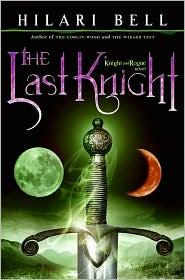
Review: The Last Knight - Hilari Bell

Synopsis: Knight errants don't exist anymore; such an occupation became obsolete a long, long time ago. So what is a rogue - a good-for-nothing, a real dastardly little con artist - like Fisk doing serving the world's last and only knight errant - Sir Michael Seven Oaks - in existence? That's what happens when helpful jerks like him rescue you from the noose.

For all of his complaining, though, Fisk certainly cannot disagree about one thing: with Sir Michael, he sees more than enough adventure. And their latest "gallant" escapade has seen the escape of a nefarious murderess, the Lady Ceceil, from a tall tower that only a damsel in distress should occupy, and of course Fisk and Sir Michael are the ones who must recapture her. Personally, Fisk would rather conveniently forget about the whole mess.


But something's very fishy about the circumstances surrounding Lady Ceceil's supposed poisoning of her husband, and Fisk and Michael soon find themselves acting as detectives to discover the truth. And there's lots of people who don't want them to find anything out.


Review: One word: hilarious. I usually hate characters like Fisk - no honor, "dashing" rogue, womanizer, irritating sarcasm (I love sarcasm, but not the type that's usually employed by adolescent males). Fisk is certainly a womanizer (more on that later), but he's hilarious in every other respect. Few books cause me to laugh out loud; this one did.


Michael, too, was not without his sarcasm. Hilari Bell used a very interesting method of first person narration that works very well when done properly: she switches narrators every other chapter, rotating between Fisk and Michael. She does it very well, giving an opportunity to represent both of their opinions, which livens the story up even more.


Unfortunately, sometimes the humor leans towards the immature college type of humor (this is mostly Fisk's doing), involving certain body parts and such things as those. There isn't so much that it makes it unreadable, but the times that it does appear, it's very annoying.


For the most part, though, The Last Knight was good. I look forward the next one.

Overall Rating: 
|||||

Others in the Rogue & Knight Series:
1)The Last Knight
2)Rogue's Home
3)Player's Ruse

Saturday, May 14, 2011

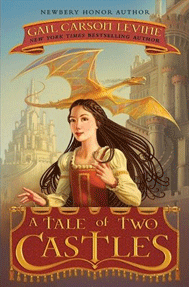
Review: A Tale of Two Castles - Gail Carson Levine

Synopsis: Elodie's parents, simple farm-folk in Lahnt, send her to the magnificent city of Two Castles to apprentice as a weaver. But head-strong, sensible Elodie has other ideas. She wants to become a mansioner - an actress - and she's willing to do whatever it takes to get an apprenticeship.

Despite her obvious skill, Elodie's dreams are quickly crushed when the mansioner master sends her away. But Meenore, Masterness of deduction and induction - and the resident dragon - takes Elodie in as an assistant. Elodie isn't sure what such a life will bring, and she certainly isn't prepared to go disguised as a kitchen maid in Count Jonty Um's (the resident ogre's) castle and solve the mystery of who's threatening his life - and who kidnapped his dog?


Review: A Tale of Two Castles (which, by the way, has no resemblance to Charles Dickens's A Tale of Two Cities) isn't what I expected - and I mean that in a good way. I love Gail Carson Levine's stories. I love how she's inspired by old fairy tales (in this case, Puss in Boots) and how witty and self-reliant her heroines are. And I love how she actually weaves a plot into love stories. I was expecting A Tale of Two Castles to be like all her others.

It isn't; not exactly. Elodie is certainly witty and self-reliant. I like her just as much as Ella (from Ella Enchanted). But this isn't a romantic story; it's a mystery story with a dragon version of Sherlock Holmes. It was quite unexpected and thoroughly enjoyable. Jonty Um is not your typical ogre. He's polite and quiet, appreciates honesty, and not green or particularly ugly. And Menoore is just awesome. He (in Elodie's world, one does not refer to a dragon as he or she, but IT. However, I maintain that Menoore is a he) hit an immediate chord of likableness with me, and being a Sherlockian, I could appreciate his deduction and induction abilities.

A Tale of Two Castles comes highly recommended. I was pleasantly surprised by this new type of story and I'm thoroughly glad that I bought it.

Overall Rating: 
|||||

Saturday, May 7, 2011

Review: The Floating Islands - Rachel Neumeier

Synopsis: After a terrible volcano eruption destroys Rounn, killing Trei's family, Trei makes his way to the stunning and majestic Floating Islands, to live with his uncle. There, he first sees the kajuraihi - men who soar the skies with wings. Trei is instantly sky-mad, and desperate to be a kajurai himself. The only one who fully understands his passion is Araene, his cousin, who has her own dreams of becoming a chef. But she is a woman, and on the Islands women can only marry and have lots of children.

But Araene's dreams take an unexpected turn when she discovers that she has a great gift that she shouldn't have. With Trei's help, Araene makes it come true, and just in time, for the whole fate of the Islands may rest on their shoulders.
Review: I wish I had better things to say about The Floating Islands, but I don't. Chapter 1 dumps the Reader right in the middle of the story, waiting until Chapter 3 to explain anything at all. Good luck trying to figure out which country is which, or who is who. The names of places and people are just thrown at you, and to make them more confusing, they almost all have an "ei" or "ai" ending, and there is no pronunciation guide in the back. So you'll spend over half your time slurring through everyone's vowel-infested name.

The writing is at best amateur. The Author uses the same word twice or more in one paragraph, so it reads very redundantly and blockishly. She does not believe in the period, but she's a strong believer in describing every single little movement a character makes. These she then strings together in one very long sentence with tons of commas and no end in sight. Now, Charles Dickens, Jonathan Swift, and Jane Austen can do unending sentences, but only because their style is witty and they aren't stringing together every single little movement a character is making. Okay, Charles Dickens does that sometimes, but it's purely for humor. On top of her run-on sentences, Ms. Neumeier's transitions are horrible. A character will be talking and then suddenly they're in a different room. And things also just happen for no real reason. For instance, Araene is making her way home in one scene along a street she knows very well. The Author goes on a long splurge of descriptions, and then suddenly Araene is lost. It reminded me of the writing exercises I used to do when I was younger. I would start a story with no apparent storyline. Things happened just so I could practice at phrasing, transitions, ect. And that's what it felt like reading this book - it felt like a storyboard.

Past the first five or seven chapters, things do improve. It's like this is where the Author originally started writing the story, and then someone told her that she needed to put something before it, so she cobbled a few earlier chapters together and didn't put much thought into them. Her writing improves a little bit, there's a more tangible storyline, and the Reader finally gets some of the world's politics and situations explained. The Author still suffers from an acute obsession with spices (though it feels as if her knowledge of spices is pretty limited, for she only talks of a very few over and over again), and there is still no pronunciation guide, but it doesn't feel quite so . . . storyboardish.

The Floating Islands
was relatively interesting once you get past the annoying chapters, but I don't think I'll be adding it to my collection.

Overall Rating: 
KK

Sunday, January 16, 2011

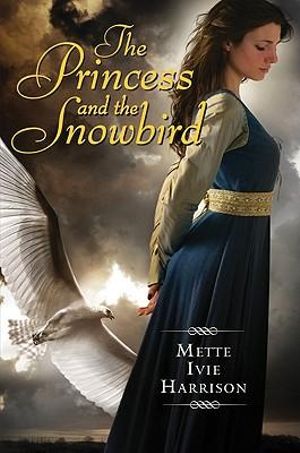
The Princess and the Snowbird Review (Mette Ivie Harrison)

Synopsis: Liva is the headstrong daughter of the hound and the bear, heiress to all her royal parents' magic and able to transform at will into any animal she wishes.
 
Jens is an outcast, a boy without magic, determined to make his way in the forest beholden to no one.

Though Liva and Jens are as different as night and day, from the time their paths first cross they are irresistibly drawn to one another. Each wrestles with demons: Liva with the responsibility that comes with the vast magic she's inherited, Jens with the haunting memories he's left behind. Separately, they keep a lookout for each other and for the immense snowbird whose appearances signify a dark event on the horizon.
 
When a terrible threat surfaces, Liva and Jens set out in an attempt to protect all they hold dear. Much is at stake - for while their failure could spell an end to all magic, their success could bring them together at last.

Review: Like The Princess and the Hound and The Princess and the Bear, this one was an intriguing story with strong, likable characters. Also like The Princess and the Bear, it isn't a stand-alone. It's not quite as necessary to read The Princess and the Bear first as it is to read The Princess and the Hound before The Princess and the Bear, but I would recommend it simply so you can understand some of the back-story that is referenced.

I liked Mette Ivie Harrison's writing style in this one better than the others. There were not as many choppy sentences and things flowed together better. However, The Princess and the Hound is still the superior story, and The Princess and the Bear an even better one than this sequel. The Princess and the Snowbird is shorter, and the storyline sometimes seems to ignore a lot of what occurred in its prequel. Also, a lot of it felt like a loosely-disguised barrage against "humans are destroying the wild; humans just take and never give back" themes. Honestly, such a theme should never be used in a book - especially adventures and romance; it always smacks of personal political opinions of the Author, and never should personal opinions influence a storyline so heavily.

Still, The Princess and the Snowbird was an enjoyable read, and I intend to buy it.

Star Rating: 3/5 (liked it)

Others in This Trilogy:

1)The Princess and the Hound
2)The Princess and the Bear
3)The Princess and the Snowbird

Saturday, January 8, 2011

The Princess and the Bear Review (Mette Ivie Harrison)

Synopsis: He was once a king, turned into a bear as punishment for his cruel and selfish desire. She was once a princess, now living in the form of a hound. Wary companions, they are sent - in human form - back to a time when magic went terribly astray. Together they must right the wrongs caused by this devastating power - if only they can find a way to trust each other. But even as each becomes aware of an ever-growing attraction, the stakes are rising and they must find a way to eliminate this evil force - or risk losing each other forever.

Review: People told me that you could read this one without reading The Princess and the Hound, but I don't recommend it. You won't entirely understand some of the things that are discussed, nor will you have a prior "connection" to the characters in it. This isn't a stand-alone sequel.

The Princess and the Bear is good, but not nearly as good as The Princess and the Hound. George is in it for a very brief moment, then never appears again, and Richon (the bear), while a good character in his own right, is not George. Just as Chala (the hound; her name changes from the prequel) is good, she isn't Beatrice, and I was not as fond of them - nor did I grow to be as fond of them - as I did with George and Beatrice.

Also, the story just wasn't as good. It was interesting and a pleasant surprise that Mette Ivie Harrison decided to write about what happens with the bear and the hound after the occurrences in The Princess and the Hound, but the story bordered far too much on being weird. A strange cat-man, unmagic killing everything in a weird plague-like way, time travel, and dead people rising (the latter isn't nearly as bad as it sounds, but it was still fairly weird). None of this beat George and Beatrice's story. I did find The Princess and the Bear a faster read than its prequel, but that is simply due to the shorter chapters. But the beginning almost made me stop because it was just strange. It jumps right into where Chala and Richon are still a bear and hound, and the Reader follows them around for a while in that form. I don't know why, but it was almost . . . uncomfortable reading those first few chapters. Perhaps it was the whole romantic attachment between a bear (who was human) and a hound - it was strange. And then a few things happen that just don't make sense and are all jumbled together. Finally, the story takes off when the wild man sends Chala and Richon back in time to save the kingdom from unmagic (don't ask me what that is; I don't know), and they gain human form. After that, the story is easier to read, but again - weird.

Despite my not liking The Princess and the Bear as much as The Princess and the Hound, I would recommend reading it if you have a desire to. Mette Ivie Harrison has one more book in this series - a series which I have dubbed The Animal Magic Trilogy - called The Princess and the Snowbird. According to her, it is a completely stand-alone book, but this one was supposed to be, too.

Star Rating: 3/5 (liked it)

Others in This Trilogy:
1)The Princess and the Hound
2)The Princess and the Bear
3)The Princess and the Snowbird

Wednesday, January 5, 2011

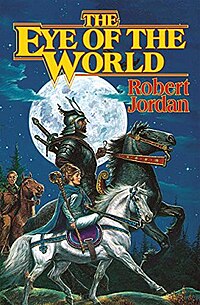
The Eye of the World Review (Robert Jordan)

The Wheel of Time turns, and Ages come and go. What was, what will be, what is, may yet fall under the Shadow. Let the Dragon ride again on the winds of time.

Not even the person in charge of writing synopsis which are found on the inside flap of a hardcover book (or on the back of a softcover, in this case) could come up with a proper summary of Robert Jordan's acclaimed masterpiece. If they did, for some reason they contrived to not put it on the back of the copy I borrowed from the library. Perhaps the Summary Writer started writing one, realized that anyone who took a half-second of a glance at it would immediately put it back, and decided, The more vague it sounds, the more readers will succumb to sheer bloody curiosity.

Well, I didn't exactly succumb to curiosity. No, unfortunately I knew exactly what I was plunging into when I picked up the first book in The Wheel of Time series. Or, at least, I thought I knew. My sister told me that I had to read at least the first book, laughing gleefully to herself. What she didn't tell me was that The Eye of the World would be a truly religious experience. . .

That is, if your religion consists of making yourself suffer as horribly as is possible. Wait! I believe Buddhism does that! Robert Jordan's series would be more appropriately named The Wheel of Suffering, not The Wheel of Time. Well, it was certainly my own little Wheel of Suffering. Though I did not finish The Eye of the World, what little I got through should ensure enlightenment for quite some time. I started reading the book with the intention of finishing it - I really did! But . . . then I looked at the Index. Then I counted the pages. And then . . . I read Chapter 1. Brisingr was easier simply because it is Young Adult fiction. This is Adult Fiction! Written by an adult! One is supposed to be waaay past this.

The Eye of the World starts with a farmboy. Surprising, right? I mean, what fantasy novel doesn't have a happy, clean, well-fed, well-spoken, educated, adolescent male suffering from a severe lack of . . . Well, everything. Now, Robert Jordan couldn't use hobbits and elves and wizards and dwarfs - oh no. But he managed to rack up . . . Oh, three very annoying adolescent farmboys (Rand, Mat, and Perrin), two men-hating women (Egwene and Nynaeve), a not-quite-a-wizard-but-knows-old-legends-and-smokes-and-has-a-white-beard dude (Thom, the gleeman), a lump who does all of the heavy work (Lan), and a female wizard lady with a glowing stick that doesn't really do anything useful until MUCH later (then the Reader and characters discover all of these nifty things it can do; things that would have solved a boatload of troubles earlier), and who hands out coins as tokens that you're not supposed to spend, but then she gets mad when you do spend it (Moiraine). Oh, yes, and later another flirtatious girl is added to the deck (Min), along with someone else and then another character who I'll get to later.

With such a large slew of characters, you would think that finding a single likable one would be fairly easy. I am laughing evilly right now, for I know most of you are thinking, Isn't there one? Well, let me put it this way: Rand is the typical fantasy farmboy - clueless, whiny, tries to be an influence to the kiddies, pretends that he isn't oogling at the passing ladies, struts around with a puffed-out chest, and shmooshes every inn's cook. Oh, yes, and of course he has a mysterious destiny that he has to come to odds with.

Mat, though, must be the most annoying out of the three. He is the "prankster," but never have I encountered a more irritating one who expresses his excitement with the most aggravating and redundant exclamations. He is also the stupidest out of the group. Example: at one point the octet of travelers are being chased by uggubuggus (i.e. monsters, or the badguy's "best soldiers") - a whole army of them. After Moiraine causes an earthquake and builds a wall of fire (something she could have done earlier!), Lan the Lump comes up with the brilliant idea of hiding out in "the one place that the Trollocs will not go." (i.e. the Trollocs are the uggubuggus.) It's a city. An abandoned city with a creepy, ominous name of Shadar Logoth. Now, this is a place that everyone would like to avoid, and our octet could've avoided it at all costs - or no cost at all. But, no, instead they decide to camp there. Mat, Rand, and Perrin go exploring. At night. They encounter a weird suspicious-acting old man by the creepy dark name of Mordeth. They follow this creepy dark fellow of the creepy dark name of Mordeth into a creepy dark staircase into a creepy dark room with lots of glittery treasure. Mordeth encourages them to take some. Through a series of not-so-complicated, but very-uninteresting events, the trio discovers that Mordeth is a dark spirit-type thingy. What a shocker. It is only after this that Moiraine informs the three stupids that, "Oh, this place is cursed and there's spirits that will kill you if you wander about at night, and by the way, there's this really bad spirit named Mordeth who will possess you if you accept any of the treasure." Talk about an FYI! Now, Mat did take something from the treasure - and after hearing this, he doesn't return it. This piece of the treasure is, of course, cursed, and it ends up, um "haunting" him later. Not only can I not believe the sheer stupidity of Mat in this escapade, but it also boggles my mind as to why this scene was even necessary. There was absolutely no reason they had to go into that city, and there is absolutely no reason why Moiraine didn't tell them earlier about the city's skeletons in the closet.

Perrin is the least annoying out of the three, but he's still pretty vexing. The only thing that keeps him from being as annoying as Rand and Mat is the fact that he doesn't talk much. Something ends up befalling Perrin, too - I didn't exactly read that part, though I skimmed it. Let us just say that Perrin contracts yellow eyes (oddly enough, none of his friends seem worried by this), and he has a yearning for raw meat, hunting, and he starts growing a bit of gray hair in places that hair isn't supposed to grow on people. Next he'll be howling at the moon. No one knows why this happens - no one cares. Next there will be a vampire.

Lan. There is not much to say about Lan the Lump. He's . . . someone. Who does . . . something. Every once in a while, Lan the Lump spoke sense. When Egwene complained for tea, he snapped "No tea!" When Egwene joins the sextet (this is before it's an octet), he makes a wonderful observation that she will serve no use. Sometimes I liked Lan the Lump, but personally, a bush would have made more contributions as a main character.

The only good character was Loial. Sadly, Loial does not appear until much, MUCH later, and even he could not get me to read those last few chapters entirely. Loial is a quiet, bookish, shy, polite sort of character. He was out of place in the story, and I wish I could adopt him. But I can't. Not unless I wrote a story with Ogres. Yes, Loial is not a human, but an Ogre - or, rather Ogier, as Jordan thought he must spell it. It is sad, Readers, when the only completely-likable character is an Ogre. Shrek even had other characters that were more likable than the ogres.

And now that I have done my litany on characters, I will move on. I have heard from several fans and ex-fans who met Robert Jordan that he was a conceited jerk. I'm not surprised; it shows in his writing. Mr. Jordan clearly saw himself as a master storyteller. I have seen worse writing, but those authors have had the excuse of youth and inexperience on their side. In the 19 chapters (294 pages) that I read word-for-word, I encountered some of the most hilariously-bad phrases I have ever seen. These are the three main highlights:

"Stars gleamed like points of light" (pg. 146) [No comment.]
"Rand's heart shriveled like an old grape." (pg. 268) [Seeing that Rand is the main character, at this point the story should be over.]
"So this is what battle is like." (pg. 146) [Rand's most profound thought.]

On top of these three most brilliant phrases, Robert Jordan also seems to suffer from the Capitalization Bug. The Capitalization Bug is when an author randomly capitalizes words to stress that they are important, without explaining why they are important. Note: capitalizing a word does not make it important. My list of RCWs (Randomly Capitalized Words), at the end of 294 pages, was 64. What I read was not even half of the book. And none of those words in that 64 are counted twice. Jordan capitalized words like Traveled (that was our favorite), All, Power, Children, Spirit, Common (and not the commons of a town), Exile, Longing, Web, Sword That Cannot Be Touched, and various colors. Jordan also thinks that if he repeats a single word over and over enough times, people will become as excited over a scene as he did when he wrote it.

Then there's the random clubs. Clubs whose jobs, positions, political standings, and whatnot are not explained (clearly the Reader is supposed to magically know about them already). There's goodie clubs that turn out to be baddie clubs (at least, I think they were baddies), and then baddie clubs that turn out to be goodie clubs. And of course all of the clubs in between. Jordan has so many clubs that he runs out of names and starts to color-code them (no joke).

Lastly, there is the You Have to be Joking moment. It is . . . Moiraine's momentary growth spurt. I know that your head is cocking to one side and your eyes are bugged out in confusion at this point. That was my exact expression when I read this. Okay, so the setup: the octet is escaping a town - never mind which one - because some sightless maggoty fellow who is obviously just in search of directions has found them (and apparently he isn't supposed to). It is nighttime, so clearly the city gates are shut. Lan the Lump kindly asks that the gates be opened, they are, then one of the baddie clubs shows up and tries to stop them. Rather than making the baddie club-members momentarily freeze, or maybe cast five-minute blindness, Moiraine grows. As tall as the city walls - taller! She towers over the city, her eyes like twin moons (that is an almost-direct quote). One hopes that her clothes grow with her, though it is never specified. After everyone else has escaped through the now-open gate, Moiraine simply steps over the walls and continues on her merry way at her normal size. Do I really have to voice my personal reaction to this? I have read of a lot of stupid spells and whatnot, but that was special.

And before I close, I would just like to make a special note of someone who I marked as my hero in the story, even though he died as soon as he appeared. Narg the Trolloc was my absolute favorite. He clearly was attempting to assure Rand in the farmhouse (yes, Rand's farmhouse is attacked by uggubuggus; sound familiar?) that he was a friendly sort and hated to see little Rand scared. Poor Narg; he never saw the sword. Narg had more personality than a single one of the others, and I really think he ought to have be instated as the book's hero. Then maybe I would have read all of it.

And so I must close, Readers. If you are wishing to reach nirvana quickly, I suggest you read The Wheel of Time. You will experience so much suffering that your Wheel of Suffering will be ended. In fact, I don't know why more Buddhists don't read The Wheel of Time to reach enlightenment.

Cheers!

Saturday, October 23, 2010

Reckless Review (Cornelia Funke)

For Jacob Reckless, the real world holds nothing but heartache and trouble. He hates it. But in the Mirrorworld, he can escape all of that and live a life of adventure and danger. But one fateful day Jacob's younger brother Will follows him, and when an accident starts turning Will into a monster, Jacob has to abandon his usual life in the Mirrorworld and save him. Before it's too late. The Mirrorworld holds thousands of dangers not even the Brothers Grimm could dream up, but with the help of Clara - Will's true love - and a young vixen named Fox, Jacob may just succeed.
Cornelia's new masterpiece kept me turning the pages. The Mirrorworld is like a land populated with darker versions of classic fairy tales. And of course, Cornelia also populates this world with her own original creatures. As usual, her writing style is fluid and very vivid, conjuring up a world that only children are able to see. But Cornelia brings back that childhood feeling to her older Readers, making it an enjoyable read for anyone.

For those who loved her Inkworld Trilogy - Reckless will not disappoint. The Mirrorworld is as rich as the Inkworld - and just as fantastic. I really do love Cornelia's fairy-worlds; they possess the classic style of old German fairy tales. For this story, Cornelia did something a little different. While her other characters and places in previous books took on Italian names, this one had German-like names. Also, the Mirrorworld has taken on the technology and fashion of the early-to-middling Victorian era. You wouldn't think that dwarves and trolls and fairies would fit into an era like that, but Cornelia does a remarkable job with what is usually paired with medieval times, and putting it into a more modern era. I certainly never thought ogres and seven-league boots fit in with trains and factories.

The characters themselves are both enduring and frustrating - but not to a bad degree. Will's undying trust in Jacob can be a little irksome, but it is hard to fault him for it. At first, Clara threatened to be a useless tag-along who can't do anything, but she turns out to be brave and tries to help as much as she can. Fox was my favorite - she was the most sensible and kept everyone on track.

And now Jacob . . . I will admit that he wasn't nearly as annoying as I was expecting him to be. He thinks only of his brother the entire time of their quest, constantly blames himself for what happened, and is overall trying to do what's right. The times he messes up are not due to any true recklessness on his part. There are some things that just can't be stopped. Even the most experienced adventurer runs into trouble now and then. Really, what was most annoying about him was his womanizing.

No, he does not - thank goodness - chase after every girl and flirt 24/7. Nor does he always go on about his good looks, how no girl can resist him, etc. But there are plenty of alludements to his past relationships - most of which the book seems to hint eventually led to intercourse of the most intimate kind. There is actually a scene in the book that - though hinted at in the most delicate words and in as few as possible - it is clear what he and the woman are doing. It's really hard to like a character when they act so dishonorably. And Jacob is likeable in every other way! Very frustrating.

Reckless by Cornelia Funke is just as good as her other books. It's dark - there are instances that will scare younger Readers, especially when the Tailor appears - and there are more sexual alludements than I would like to find in a kid's book. They would go over a younger Reader's head, for Cornelia is never explicit, but it is something to keep in mind if you're considering reading it out loud to a kid. Other than that, it's exciting and a quick read. And judging by the way it ends, there may be a sequel in the future.

Star Rating: 4/5 (really liked it)

Others in The Mirrorworld Trilogy:
1)Reckless
2)Fearless

Friday, June 25, 2010

Castle in the Air Review (Diana Wynne Jones)

Synopsis: Young merchant Abdullah leads a humble life. Or he did until a stranger sold him a threadbare - and disagreeable - magic carpet. Now Abdullah is caught in the middle of his grand daydreams. Walking one night in a luxurious garden, he meets and falls instantly in love with the beautiful and clever Flower-in-the-Night. But a wicked djinn sweeps the princess away right before Abdullah's eyes, leaving the young man no choice but to follow. This is no ordinary quest, however, for Flower-in-the-Night isn't all the djinn had stolen. Abdullah will have the so-called help of the cantankerous carpet, a cranky genie in a bottle, a dishonest soldier, and a very opinionated black cat. Will this motley crew be able to find the djinn's mysterious dwelling and rescue a castle full of princesses?

Review: One should definitely read Howl's Moving Castle before you read this one. I admit, I was disappointed that Howl, Calcifer, and Sophie were not much in this book. But the genie easily replaces Howl in every respect, as does the black cat Sophie. And while the carpet never speaks, its attitude is strikingly like Calcifer's - sulky if it doesn't receive praise (rather reminds me of the old copier at the library, which I had to constantly wheedle before it printed). These, along with a few new characters, make Castle in the Air as fun and entertaining as Howl's Moving Castle and House of Many Ways. Abdullah can be slightly annoying, but overall he's likable and I always felt sorry when something bad happened to him. The soldier is likable also.


Diana Wynne Jones's talent for good characters also extends with the djinns - Hasruel is the type of character that I absolutely love putting in my own stories: overall he's good, but he will often stand in the background to observe the occurring events with great interest and not very interested in preventing anything. They always add a little extra to stories. Dalzel I felt sorry for.


I wish there was another book with these characters - I've fallen in love with Diana Wynne Jones's characters more than I thought I would. I'm no fan of fantasy, but the particular fantasy in these books pokes fun of itself. It's very funny. And as soon as I can find hardcover copies of Castle in the Air, Howl's Moving Castle, and House of Many Ways I'm going to add them to my collection.

Overall Rating: {{{{

Others in This Trilogy:
1)Howl's Moving Castle
2)Castle in the Air
3)House of Many Ways

Wednesday, June 16, 2010

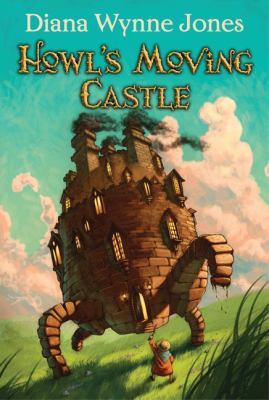
Howl's Moving Castle Review (Diana Wynne Jones)

Sophie has the great misfortune of being the eldest of three daughters, destined to fail miserably should she ever leave home to seek her fate. But when she unwittingly attracts the ire of the Witch of the Waste, Sophie finds herself under a horrid spell that transforms her into an old lady. Her only chance at breaking it lies in the ever-moving castle in the hills: the Wizard Howl's castle. To untangle the enchantment, Sophie must handle the heartless Howl, strike a bargain with a fire demon, and meet the Witch of the Waste head-on. Along the way, she discovers that there's far more to Howl - and herself - than first meets the eye.

In many ways, I'm glad I read House of Many Ways before I read Howl's Moving Castle. It gave me an opportunity to decide which characters I really wanted to get to know in this one. Who wins? Well, Calcifer is still my favorite. He's even more adorable (as adorable as a fire demon can be, and he really is quite an adorable one) and hilarious than in House of Many Ways. Yes, Calcifer will always be my favorite.


But I love the other characters almost as much as he. Howl is one of the funniest "cowards" I've ever known in the Literary World. I'm not one for dashing, roguish characters - it is my sound opinion that they ought to have a firm grandmother always watching their every action. Apparently, Sophie shared my exact opinion, and it made me bear Howl better because he spent more time being pathetic (the episode with the cold had me laughing very hard) than roguish and dashing due to the fact that Sophie wouldn't put up with it. And Howl really isn't all that roguish and dashing - he's brave and honorable, even if he denies it.

Sophie is a wonderful character! Never have I been so fond of a main female character. She spends none of her time bemoaning her fate, or really even complaining. She gets down to business and won't hear any lip from anyone else about it. Even her nosiness - which usually irritates me in a character because it brings them into stupid situations - didn't bother me. When her curiosity does bring her into a bad situation, she admits that it was her fault and deals with it. Sophie is a very practical person; I rather wish I could be like her, save for, maybe, the temper.

Which brings me to another point: normally the whole scenario of two people arguing who really love each other, but argue and pick because they don't want to admit that they love each other, really, really irritates me. It's not funny; it's just annoying, and makes both characters pretty irksome. Even unlikeable. But Sophie and Howl's bickerings were somehow different. Maybe because the whole "I-love-you-but-won't-admit-it" theme was pretty much missing. No surprise, Sophie and Howl do end up marrying, but their bickerings are part of their character - not something that started happening just because they were denying their own feelings. And also, both handle the other's bad tempers pretty well! Sophie chides Howl or ignores him (the latter mostly) when he starts pouting, and Howl just gently teases Sophie or leaves her alone when she is angry. Howl is also a "slitherer-outer" - as Sophie calls him, - so he doesn't seem to pursue an argument for very long.

I really did enjoy this book. Like House of Many Ways, it has a lot of the same Victorian-ish humor; poking fun at itself and taking cliche myths and housewife sayings and turning them real, making for very hilarious situations. As I said in my review for House of Many Ways, any story that can make an inanimate object a lovable character (in this case, a skull and a scarecrow) is definitely worth reading.
There's apparently a third book - Castle in the Air - and I'm going to read it. But like House of Many Ways, Howl's Moving Castle can also work as a stand-alone book. But I guarantee you that after reading it, you'll want to read the others.
 
Star Rating: 4/5 (really liked it)

Others in This Trilogy:
1)Howl's Moving Castle
2)Castle in the Air
3)House of Many Ways

Saturday, June 12, 2010

House of Many Ways Review (Diana Wynne Jones)

Charmain Baker is in over her head. Looking after Great-Uncle William's tiny cottage while he's ill should have been easy. But Great-Uncle William is better known as the Royal Wizard of Norland, and his house bends space and time. Its single door leads to any number of places - the bedrooms, the kitchen, the caves under the mountains, the past, and the Royal Mansion, to name just a few. By opening that door, Charmain has become responsible for not only the house, but for an extremely magical stray dog, a muddled young apprentice wizard, and a box of the king's most treasured documents. She has encountered a terrifying beast called a lubbock, irritated a clan of small blue creatures, and wound up smack in the middle of an urgent search. The king and his daughter are desperate to find the lost, fabled Elfgift - so desperate that they've even called in an intimidating sorceress named Sophie to help. And where Sophie is, can the Wizard Howl and fire demon Calcifer be far behind? Of course, with that magical family involved, there's bound to be chaos - and unexpected revelations. No one will be more surprised than Charmain by what Howl and Sophie discover.


This, apparently, is the sequel to Howl's Moving Castle. I didn't read Howl's Moving Castle first (though now I certainly intend to), and it seems that House of Many Ways can act as a good stand-alone book. That said, time to move on to my review.


First point: it's funny. I would venture to say that there is even a bit of an early-Victorian flair in its style and humor. Especially with Charmain's Aunt Sempronia and the various tea parties that Charmain inadvertently disrupts. Diana Wynne Jones also throws in various humorous spins on famous myths - the pot of gold at the end of the rainbow, dirty laundry breeds (which is a fact that my mom will testify to), etc. The chaotic scenes are not slapstick chaotic - they are very funny and rather ordered in their chaoticness.

Second point: the characters. Charmain can grate upon the Reader's nerves - thankfully, this book in not written in first person, so her irritatingly-quick temper does not get overly annoying. To her credit, Charmain does attempt to be kinder to people, and she cannot entirely help the fact that she doesn't know how to do any household chores - that would be her mother's fault. But in short order, you get used to Charmain and don't mind her too much. Peter is more annoying that her, because he thinks he knows how to do everything, but really doesn't. He bungles his spells all the time, causing more problems. But there's something endearing about him in his know-it-allness. But my favorite character (aside from Waif the dog and The Boke of Palimpsest; it's always a good sign when a story can make a book a funny character!) was Calcifer. There was something about the fire demon - who is nothing more than a blue flame with red eyes who sleeps in fireplaces - that I really liked. Howl was not in the story enough as himself for me to fully enjoy him, but what short time he was, I liked him as well. Still, Calcifer stands out as my favorite.

The one complaint I have is a very small one - that being the Author constantly inserted the utterance of "Er" in dialogue. To me, that's a sign of weak dialogue writing and it gets on my nerves. But my overall enjoyment of the comical story and likable characters overshadowed this minor annoyance. I'm not a fan of fantasy, but comical fantasy like this - fantasy that pokes fun at itself - I like. The slight Victorian flavor made it even more enjoyable. I'm going to read Howl's Moving Castle as soon as I can and I'll probably end up buying at least House of Many Ways.

If you're looking for a relaxing, amusing read, House of Many Ways is definitely a good pick.

 
Star Rating: 4/5 (really liked it)

Others in This Trilogy:
1)Howl's Moving Castle
2)Castle in the Air
3)House of Many Ways

Friday, March 19, 2010

Brisingr Review (Christopher Paolini)

Seventeen-year-old farm boy, now Dragon Rider, Eragon and his blue dragon Saphira are back for a third installment of Christopher Paolini's Inheritance Cycle - a fantasy series considered epic by many readers. The continued stupidity of Eragon is about the only thing epic in this series.


Normally a fast reader, it took me a week and a half to get through the 745-page Brisingr. And even now I puzzle over what made it so bloody long! The chapters mainly focus on the political struggled of the Varden and especially the dwarves - as if there wasn't enough of that in Eldest. And while the politics surrounding a war are definitely important, none of it contributes to Brisingr's supposed plot.


Wait, there was a plot?! If there was, I certainly missed it among the laughing soldiers who can't be killed - unless you stab them through the left nostril, their foot, or the armpit -, Eragon's conversing with the surrounding foliage and wildlife (yes, the ants are back), and Roran's constant doubting of his leadership qualities, as well as his dislike for killing. (Ironically, in one battle, he ends up slaying nearly 200 people, and is seemingly unaffected by it afterward, whereas he has reoccurring nightmares after other battles that Mr. P finds necessary to relate in detail.)

And if you hoped that there would be character development, you will be sorely mistaken. Eragon has elf abilities now, but he still passes out about every other chapter, and exhausts his stamina gauge. Never mind he can punch straight through someone's stomach and not feel light-headed at all after getting a compound fracture. He is still as whiny as ever, and his intelligence level hasn't upgraded in the slightest.

There are a few moments with Arya where the reader sees a softer side of her, but they are few and far in between, and really do not contribute to her character at all. It just leaves the reader thinking "O-kay, so one moment she was sharing sentiments with Eragon around a campfire, and now she's slashing and hacking and acting as uppity as ever!"

I found Roran to be very tiring - particularly when he slew nearly 200 men on his own while gushing blood from his femoral artery. And then he doesn't die. After that moment, he simply becomes a killing machine with a big warhammer in tow. For a while, Mr. P shows signs that Roran may be able to use magic - which is demonstrated in a few nonsensical scenes where he tries (unsuccessfully) to levitate a pebble -, but that is left open for speculation. This may be because Mr. P has plans for it in the fourth book, but doubtful.

About the only character(s) who develop are the Urgals! Urgals, people! That is sad! And even they are not as developed as one would hope. They are still very much portrayed as hulking brutes with ram's horns and yellow eyes that go about grunting and roaring. This portrayal makes the character developments hard to take seriously (though none of this beats the part in Eldest where Eragon experiences the Urgal's childhood).

A good portion of this book focuses on the dwarves (yawn!), and the majority of that is spent with the clan chiefs bickering back and forth about this and that, and one clan giving Eragon the evil eye because he's a Rider. The only redeeming quality during those many chapters are the Star Sapphire is repaired, and Eragon is attacked by ninja dwarves! But unfortunately not killed.

The battles should have offered some variation, but they didn't. One is so abrupt that I literally jumped in my chair. One moment the Varden are being merry and preparing for a wedding, and then BOOM! There's an army of non-pain-feeling laughing soldiers on the horizon! And - surprise, surprise -, the "evil" Murtagh shows up, and he and Eragon have their usual conversation that suspiciously resembles ones Darth Vader and Luke Skywalker have. The most disturbing thing I found about that particular battle was afterward, everyone acted like nothing had happened, and they went back to being happy and merry.

The other two battles consist of Muscleman Roran and his skull-smashing hammer doing hundreds of baddies in. And the Varden siege resembles a role-playing game so much that you automatically wonder, "Did I save the game?" when a character enters a building.

What few plot twists the book has are so obvious that you could predict them with only reading the first book. I won't waste time expressing the similarities between it and Star Wars (and goodness, are there a lot!), and in order to cover all of the absurdities in this dreadful volume, I would have to write an essay. But I won't. I'll just end it with these words: I have never in my life had to force myself to read a book - not even for school. I dreaded every time I picked this book up.
Overall Rating: 

(special awfulness award)


Others in the Inheritance Cycle:

1)Eragon
2)Eldest
3)Brisingr
4)Inheritance