Tuesday, August 3, 2010

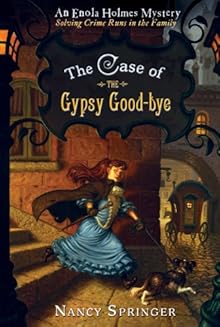
The Case of the Gypsy Good-bye Review (Nancy Springer)

Synopsis: As Enola Holmes - much younger sister of Sherlock Holmes - searches for the missing Lady Blanchefleur del Campo, she discovers that Sherlock is just as diligently searching for Enola herself - and this time he really needs to catch her! He is in possession of a most peculiar package, a message from their long-lost mother that only Enola can decipher. Sherlock, along with their fastidious brother Mycroft, must follow Enola into the reeking tunnels of London's dark underbelly as they solve a triple mystery: What had happened to their mother? And to Lady Blanchefleur? And what does either have to do with Mycroft, who holds Enola's future in his ever-so-proper hands?

Review: I have been an avid reader of Nancy Springer's Enola Holmes series, and I have enjoyed every single one of them - even if her rendition of Watson and Holmes are not entirely accurate. Enola is a hilarious and quite engaging character - one that is easily liked. She is a bit naive and follows her instincts often without prior planning, but she is able to scrape her way out of predicaments that keep the Reader from getting frustrated with her. I've found Nancy Springer's series to be full of rich Victorian-England facts that - thanks to research on my own part - I feel that I can trust entirely to being accurate.

That said, I hate to confess that The Case of the Gypsy Good-bye was not my favorite. It wasn't necessarily a disappointing ending, and everything wrapped itself up well. But it was lacking in the general feel of the rest of the books. The codes, clues, chases, disguises . . . I liked that Nancy Springer revisited characters and Enola's roles - sort of like a trip down Memory Lane. It made me feel content. But all of the other books have held a sort of darkness to them. The Reader could feel the cold, clammy streets of the East End, the panic and heartthrob as the garrotter tightened the cord about one's neck. I didn't get that feeling at all in this one. Dark London was not made present, and that has partly been the very essence of Enola Holmes. Nancy Springer has presented the beautiful and the dark of London in every story in new and interesting ways, but the series's conclusion . . .

Still, Nancy Springer could have given a very unsatisfactory ending, and if all I have to complain about is that, then I am satisfied. I wish the series weren't done, but at least it went out well.

Overall Rating: |||||

Sherlockian Rating: |||||

Others in the Enola Holmes Mystery Series:
1)The Case of the Missing Marquess
2)The Case of the Left-Handed Lady
3)The Case of the Bizarre Bouquet
4)The Case of the Peculiar Pink Fan
5)The Case of the Cryptic Crinoline
6)The Case of the Gypsy Good-bye

Monday, August 2, 2010

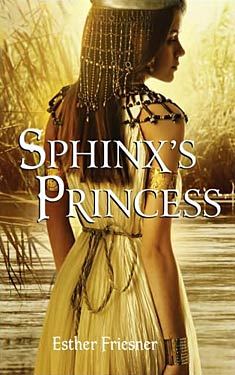
Sphinx's Princess Review (Esther Friesner)

Nefertiti is a dutiful, docile child, whose only interests, aside from the normal pursuits of a commoner's daughter, are music and dance. But an encounter with a scribe arouses secret lessons in the arts of reading and writing. As she enters her teen years, her growing beauty and her developing singing and dancing skills attract attention near and far. And when her aunt, Queen Tiye, summons Nefertiti's family, her life takes an unexpected turn. The strong-willed queen plans to use Nefertiti as a pawn in her desire for power. Even though she must obey the queen and live in the royal palace at Thebes, Nefertiti's spirit and mind will not rest. She continues to challenge herself, learning how to drive a chariot and hunt with a bow. With control of a kingdom at stake and threats at every turn, Nefertiti is forced to make choices and stand up for her beliefs in ways she never imagined.

I absolutely love stories about Ancient Egypt. At the age of seven, I gobbled up every book the local library afforded on Egyptian history. I became an expert on the Egyptian mummification process at ten years of age - that is still an accomplishment that I am especially proud of, though I confess that I am a tad bit rusty on the process now; it's been years since I have reviewed. When I went to the Field Museum in Chicago many years back, I only cared about the Egyptian display and practically went bonkers when my friend's mom surprised us with tickets to the King Tut exhibit that was visiting then. I cannot describe the untold joy I had rushing from one display case to the other, babbling on and on about the artifact therein and the theories surrounding this city and that pharaoh. I had employees asking me if I would care to come work there someday (my reply was a yearning yes, but sadly I don't think I could live in Chicago even for my beloved mummies). I am not entirely certain why Ancient Egypt held such allurement for me, but I was fascinated by them even more than the Romans - which is saying a lot for me. I wanted to be a professional Egyptologist, until I found out that being one mostly meant teaching at a university, rather than gallivanting off to Egypt to visit the pyramids and Giza Plateau. I ought to have been born in a year that would have permitted me to be in my early 20s when King Tut was discovered.

That said, let me now review this book. Nefertiti is one of the royal Egyptian figures that I used to read about the most, but I have regrettably forgotten most of what I read about her over the years. Nevertheless, I found Esther Friesner's take on how Nefertiti came to power fairly compelling. Her writing style captured the richness of Egypt in a way that I have not encountered in fiction for a while. I cared for Nefertiti, her little slave girl Berett, and Henenu - who was my favorite. At times, I even found myself caring for the minor characters just as much as for the major - sometimes even more so. What an accomplishment when an author can do that!!

The story itself is intriguing. At first, I found that to get to the actual storyline took a little while, and I was slightly bored in the beginning. I wouldn't ask nor advise Esther Friesner to cut out these passages, because they were certainly important for laying out the groundwork for the story. I imagine that when I go back to read Sphinx's Princess again, I won't find the passages so boring. Sometimes it's just the mood I am in.

I especially liked how Esther Friesner blended in Egyptian beliefs without giving the story a supernatural or fantastical feeling to it. The only thing that approaches fantasy is the dreams Nefertiti sometimes has. The way she included the Egyptian religion felt very authentic, unlike most authors, who somehow end up muddling the whole affair. I have always had trouble keeping the different Egyptian gods and goddesses straight in my head, but Ms. Friesner actually helped me remember who was who and what they were in control of. I am glad that I am not Catholic, for it must be just as confusing keeping all of the saints in order. ;)

I enjoyed Sphinx's Princess and look forward to reading the sequel - Sphinx's Queen. I also need to read Esther Friesner's two books about Helen of Troy - Nobody's Princess and Nobody's Prize. Unfortunately, the library doesn't have them . . .

Star Rating: 4/5 (really liked it)

Others in This Series:
1)Sphinx's Princess
2)Sphinx's Queen

Tuesday, July 20, 2010

Dinotopia Lost Review (Alan Dean Foster)

In all Dinotopia's countless centuries, rarely has a vessel reached her peaceful shores except as a splintered wreck, until a mighty, storm-swollen breaker hurls the pirate ship Condor beyond the treacherous fangs of the coral reefs that surround the island. When marauding pirates capture a family of Struthiomimuses, young skybax rider Will Denison leads a tiny band of rescuers on a pursuit that takes them into the perilous Rainy Basin, where tryannosaurs still stalk the steamy forest long abandoned by civilized Dinotopians. Doggedly tracking the invaders, Will and his companions, Chaz and Keelk, must face many dangers - both old and new.

As a child, I loved Dinotopia stories! All of them involved exploring and danger and adventure. More often than not, I found myself more attached to the saurian characters than the human. I was first interested in Dinotopia when I saw the Hallmark mini-series. It wasn't until one of my friend's loaned me The World Beneath and A Land Apart from Time that I realized how much the TV series distorted James Gurney's original stories - a fact that still irks me to no end. I was sorry that James Gurney hadn't written more Dinotopia books - his were my favorites, - but I gobbled up the paperback series very quickly, as well as the two books Alan Dean Foster has written - The Hand of Dinotopia and now Dinotopia Lost. The only Dinotopia book I haven't read is First Flight - which is, unfortunately, extremely difficult to gets one's hands on because it is out of print.

Dinotopia Lost wasn't entirely a letdown. It had the same sense of adventure and exploration. Even though these stories take place in a utopian society, the villains always get their comeuppance. Their demise is rarely as satisfying as it could be, but at least people still die. And one cannot have a good adventure story without some characters dying. What I have always mainly loved about these stories is the era. I love the fact that James Gurney chose the 19th century - and added a great deal of that same flavor to Dinotopia itself. I doubt I would have been as enchanted with his world if he had done otherwise.

But reading these stories now, at an older age, is interesting. I have a different perspective on it. I still love the adventure, the humor, and of course Will Denison (I wish this particular one had had Sylvia in it; she's a favorite as well). But when I was little, I was able to block out the flaws in basing stories in a utopian society and just enjoy the adventure. Now, it was more difficult. I couldn't ignore Alan Dean Foster's spouting of utopian ideals - aspects that always made the TV mini-series nauseating to me, even as a child - and the overall sense that he was disparaging the world. I tried to become drawn into the story, but with every phrase consisting of "in harmony with" or "helping each other," I could not help but repeat silently to myself, Utopian societies just don't work. History has proven that. The nice thing about James Gurney's Dinotopia books is he spends more time concentrating on the adventure and exploration than ideals.

Unfortunately, that wasn't the only thing that irritated me about Dinotopia Lost. There are pirates. Now, pirates were in existence in some parts of world during the 19th century - pirates still exist to this day. But the pirates in this story seemed as if they belonged more in some poorly-written swashbuckler, whose author (it is painfully obvious) has spent all of his life in a landlocked location and has gained all of his "sea knowledge" from equally-inaccurate sources like Pirates of the Caribbean.

I will always enjoy Dinotopia stories to an extent - they were a part of my childhood. But reading ones that are written by someone else other than James Gurney are not as enjoyable now as it once was. Still, I am pleased to at last be able to say that I have read all Dinotopia books, save one.


Star Rating: 3/5 (liked it)

Sunday, July 18, 2010

Camilla Review (Madeleine L'Engle)

Synopsis: Fifteen-year-old Camilla Dickinson has led a sheltered life on the Upper East Side of New York City with her architect father and stunningly beautiful mother. But this winter the security she has always known is vanishing as her parents' marriage begins to crumble - and Camilla is caught in the middle. She finds a way to escape her troubles when she meets Frank, her best friend's brother, who is someone she can really talk to about life, death, God, and her dream of becoming an astronomer. As Camilla and Frank roam the streets together lost in conversation and he introduces her to people who are so different from those she has met before, he opens her eyes to worlds beyond her own, almost as if he were a telescope helping her to see the stars.

Review: I can see this book being enjoyed by certain people, but for me it was a waste of time. I don't care for coming-of-age stories and families being ripped apart by cheating parents and divorces. I don't care to read about adolescent romances or the pubescent thoughts of girls - or especially boys. I simply don't care. It doesn't make for an interesting story and it lacks plotline and villains. It also leaves one feeling depressed, because no one - once they have gone through puberty - desires to read about it and bring all of those horrid memories back again.

It was depressing. Utterly depressing! I like family dramas, but only when they involve nations going to war like the Medieval and Elizabethan eras. Or Mongolian tribal fights. Not when it is about day-to-day family dramas involving simply messed-up people who care only for themselves and not their children. Life is too full of such situations. I certainly cannot see how someone who has come from that background would enjoy reading a book about it! I don't come from such a situation and I didn't enjoy Camilla. The only redeeming quality about this story was the era that it takes place in. But that's it.

I won't be buying Camilla by Madeleine L'Engle. It wasn't poorly written - though whenever Camilla's mother's dialogue came up, I groaned. Very choppy and annoying to read, - but the storyline was uninteresting, depressing, and the ending extremely abrupt - as endings for stories with no storyline tend to be.


Overall Rating: KK

Thursday, July 8, 2010

Alphabet of Dreams Review (Susan Fletcher)

Synopsis: Mitra and her little brother, Babak, are beggars in the city of Rhagae, scratching out a living as best as they can with what they can beg for - or steal. But Mitra burns with hope and ambition, for she and Babak are not what they seem. They are of royal blood, but their father's ill-fated plot against the evil tyrant, King Phraates, has resulted in their father's death and their exile. Now disguised as a boy, Mitra has never given up believing they can rejoin what is left of their family and regain their rightful standing in the world.

Then they discover that Babak has a strange gift: If he sleeps with an item belonging to someone, he can know that person's dreams. Mitra believes that they can use this gift to find passage back to the city of Palmyra and their remaining kinsmen. But soon Babak and his abilities come to the attention of a powerful Magus - one who has read portents in the stars of the coming of a new king and the dawn of a new age. Soon Mitra and Babak find themselves on the road to Bethlehem.

I really was not expecting this story to be very good. I was expecting it to be downright weird. Twists on the Christmas story tend to be. But Alphabet of Dreams actually wasn't! Granted, it did have a small sense of weirdness - any story having to do with dreams will. But it tied in well with the Magi and the journey to Bethlehem. I was pleasantly surprised.

Mitra is a character that one can get frustrated with very easily. She's a good character and cares for Babak in a sisterly fashion that would make anyone like her. But her constant desire to escape and go to Palmyra grows annoying. She's bad at planning escapes and so it always goes wrong for her. She's one of those characters that always makes the same stupid mistake and never learns. But apart from that, Mitra isn't entirely unbearable. And Babak is just too adorable and sweet.

My favorite character, though, was Giv. The exact moment he stepped into the story, I liked him. Giv conserves his words, watches out for Mitra and Babak diligently, and is just overall an awesome character. I really liked him; the exact sort of character I absolutely love to put into my own stories. As a Reader, I trusted him right off and was irritated with Mitra for not feeling the same way. Giv made the story worth reading.

Susan Fletcher's writing style really shone in this story. The only irritating aspect in it is a very minor one. There was one character - Koosha - who is fairly minor and he's not in it for long. But he often uses the word "savage" to describe something awesome. Like "savagely soft wool." It felt like a replacement for the modern phrase "wickedly good." It felt very out of place. But, again, Koosha isn't in the story much, so it's a minor annoyance.

Overall Rating: {{{{