Tuesday, December 27, 2011

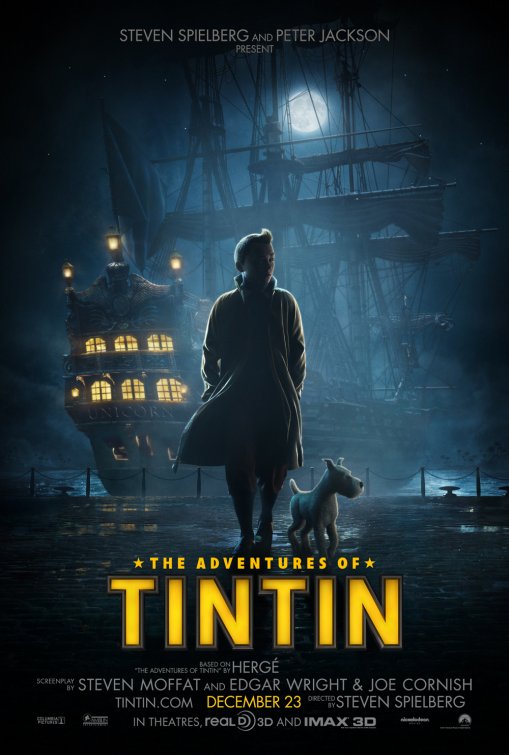
The Adventures of Tintin

Rated: PG
 
First off, I have not ever read any of the Tintin comics, so I'm not writing this review from the perspective of someone who is comparing the film to the books. Therefore, if there were any inconsistencies in the movie, I didn't catch them - fans, feel free to inform me of any. I'm more than willing to learn.

Unless the movie was way off from the books, I imagine that even if I had been versed in Tintin's adventures prior to going, I would have enjoyed it as much as I did. I would have loved this movie when I was little. It would have even beaten out Indiana Jones (which was my ultimate favorite adventure series when I was little) by quite a lot, if only because Tintin is a far more likable character than Indy, and Harrison Ford didn't play him.

The computer animation in this was just astounding. I am not one who is very impressed with CG and the like - yes, it is nice when CGI looks real, but I really don't give much thought either way (unless it is just horrible). However, this is one time where I would actually say the movie was worth seeing just for the animation. The people are eerily realistic looking, and there were several times where I had to do a double-take when the camera panned over the "extras," to make sure they weren't real. It was amazing, and added to the overall appeal of the movie.

While a kids' movie, I think most ages would enjoy it. The storyline isn't very surprising - the mystery and clues easy to put together, but it's entertaining nonetheless, and there are many instances where the dialogue is actually very funny. Here was a time where the comic-relief character (Captain Haddock) truly managed to be amusing and not just irritating. It being geared more towards kids, there are, of course, a few chaotic scenes that got a little wearing, but they don't last super long, and they are very few. 

All in all, I thought The Adventures of Tintin was a very fun, quite amusing, and very well-done film (the acting, even though you could not see the actors themselves, was brilliant), and they planned for a sequel intelligently, ending it to where if, for some reason, they decide not to make a second, it doesn't ruin the ending of the first. For the truth is no adventure can just end where everything is wrapped up in the end. There has to be something more, even if the Reader (or, in this case, Viewer) doesn't get to see it for themselves. Seeing this movie made me feel like a kid again, and I can safely say that even now, at my age, it's my favorite adventure movie. Indiana Jones just lost its honorary place among my adventure collection.

Wednesday, December 21, 2011

Sherlock Holmes: A Game of Shadows

Rated: PG-13

First off, let me say that the trailer has, once again, fibbed, for the movie was not nearly as bad as it made it out to be, and you don’t know how glad I am to be able to say that. I was so worried that they were going to mess it up by trying to out-do the first one. Thank goodness, they didn’t.

That said, I will admit that A Game of Shadows was not as good as the first one. Nor was I anticipating it to be. Don’t get me wrong – it was very good, and I have every intention of buying it, and may go and see it in theaters at least one more time (making a total of three viewings). But it simply was not as good as the first. There were a few scenes where I think the makers were trying to out-do the first one, but then realized that perhaps that wasn’t such a good idea, and stopped. The action level was not upped by much, but due to the manner in which they filmed the action sequences, it felt like there was. The biggest action scene I had an issue with was a part towards the end, when Holmes and Co. are running through the woods while being shot at with guns and heavy artillery. The makers put the majority of this scene in super, super slow motion; they were trying so hard to convince the Viewer that this was an intense scene, and all they ended up doing was producing a dragged-out, kind of weird action sequence that didn’t fit in to a Holmes movie. It’s almost as if they were making up for the fact that the movie is not in 3D (which I am profoundly glad it isn’t).

The train scene was almost as bad. Again, I don’t think it was necessarily a very long sequence, but it felt like one, due to the deviation from good dialogue and overzealous use of heavy guns. Now, I love big guns – the artillery and whatnot was way awesome, and completely fine. It was the way they used it – ripping through train cars and exploding trees in slow motion. It just felt a little excessive. And as for Sherlock dressing “in drag” during this train sequence, as a whole, I didn’t mind it at all – Holmes often disguised himself as a woman in the stories. But once the shirt came off, it became evident to me that the makers did it to give Downey Jr.’s abs some showtime, and that I do have an issue with, because then it is a deliberate deviation from the character’s behavior.

The other issue I had was Irene Adler, and I am so pleased that she left the story when she did, because her dialogue had become far less than pleasing. Irene’s character was more than threatening to become “The Flirt.” A female character whose sole purpose is to say sassy things to the hero, while being flirtatious and essentially eye-candy with an Attitude. Oh dear; when Irene started talking, I sighed heavily in my chair and prayed that she would not be in it long. The makers walked a fine line with her character in the first one the way it is, and they crossed that line for the few moments that she was in A Game of Shadows. I am also not entirely certain how I feel about the scene where Watson is drunk, for it seems to me that it was inserted merely for laughs, and my Sherlockian radar whirred a bit in protest. However, these two complaints are fairly small, since the scenes concerned are short.

What about Mycroft in his birthday suit? Those of you who have already seen the movie are probably dying to ask me that very question. Well, for one thing, no one should have to see that much of Stephen Fry – ever, – but I did think it funny, and I could actually see Mycroft doing that. Frown at me if you want, you Basil Rathbone fans – I could see Mycroft wandering about his house with not a stitch upon him!

It may seem that I have a great many things to complain about, but I have many things that I liked. For one, I loved Mary Morstan’s more active role in events (they continue to do her superbly), and Simza was entirely believable. I am so glad that they did not try to give her The Attitude, made her a macho-chick, or even attempted to turn her into a new love interest for Holmes. The dialogue, for the most part, was very funny while remaining true to the characters, and Moriarty was amazing. They could not have done him better; he possessed the cold calmness Moriarty displays – never allowing his temper to show, never leaves loose ends, never hesitates to kill those who get in his way. And through all of this, you could see the madness behind the genius. One thing I never liked about The Final Problem was it didn’t make clear what, exactly, Moriarty was trying to accomplish – starting WWI was, while not necessarily original, still brilliant and kept true to Moriarty’s character.

While I will admit that the storyline, as a whole, was better than the first installment, it had a few too many flaws to make it as good as Sherlock Holmes “1”. When flashbacks were used to explain events in the first movie, they were easy to follow, while the flashbacks in A Game of Shadows were a little harder, because they sped through them so quickly. They tried a little too hard to impress with a few action sequences in A Game of Shadows, and even the music wasn’t as good as the first one. It fit the movie, true, but I just didn’t prefer it as much, and the ambiance of the second was more like an adventure, and less like a mystery. Which is still in keeping with the Holmes stories – not all of his cases feel like mysteries. The Final Problem felt more like an adventure than a mystery, so both movies did feel like a Sherlock Holmes story. This one just had a few more flaws. As I told many people: A Game of Shadows got progressively better, whereas Sherlock Holmes was brilliant from beginning to end.
 
However. The last 10-15 minutes – in short, the end – make whatever flaws A Game of Shadows has well worth sitting through. The final showdown between Holmes and Moriarty was sheer genius, and the solution to Moriarty’s final act that would send countries into WWI a total surprise – and a good one, at that. The scene where Moriarty interrogates Holmes, while gritty and grim to watch, was excellent – it showcased Moriarty’s insanity quite well. But the end was perfect. It makes up for everything else; completely saved the movie. If I have put you off from seeing the movie because of my complaints against the action, go see it just so you can watch the end, because I can only say one thing about it: phenomenal. Maybe you have to be a Sherlockian like me to appreciate it like I did, but I was truly impressed.

Sherlock Holmes: A Game of Shadows is worth seeing; just don’t expect it be as good as – and especially not better than – the first one. And remember what I said about the ending. I pray that the makers keep in mind whatever it is they were thinking when they filmed the end, when they make the third movie.

Tuesday, October 25, 2011

Review: David - Mary Hoffman

Synopsis: When Gabriele comes to Florence to make his fortune, he has no idea that his face and body will become the most famous in the world, stared at and admired by millions of people for hundreds of years. But when your brother is Michelangelo, things like that can happen . . .

At first, though, being asked to pose for the statue of David is the least exciting thing that happens to Gabriele as he begins his new life. There's romance - thrilling romance, with a forbidden woman who has an agenda if her own. And there's danger. The Florence of 1501 is a divided city, where rival factions fight for control, and no one can be trusted. Recruited to serve as a spy, Gabriele finds himself over his head in a web of deadly intrigue. And when the statue of David becomes the focal point for a violent dispute that threatens to tear the city apart, Gabriele must fight to protect one of the greatest masterpieces the world has ever known.

Review: This book is probably considered an edgy read, and it is certainly not without its content. Gabriele is an all-out womanizer and sleep-around. He's in Florence for one day and he's already found his way into a woman's bed, and she isn't the last. Thankfully, his interests stop at women, but there are plenty of men to make googly-eyes at him, as well, and the Author doesn't shy away from stating that fact. One patron specifically asks a painter to use Gabriele as his nude model because he (the patron) likes to look at Gabriele. And of course, there are lots of references to nudity - it's pretty unavoidable, honestly; David is about Michelangelo's famous statue, who wears not a stitch. But don't be alarmed, Readers - while the book is certainly abounding with sexual references, the Author handles it all with remarkable discretion, hinting and describing in the fewest words possible, therefore making it a book which is readable rather than just downright trashy. Mary Hoffman never gets explicit. There is an underlying wrongness, as with the movie The Talented Mr. Ripley, but it's fairly easy to ignore.

What's probably most remarkable is despite all of Gabriele's shortcomings, he still manages to be a somewhat likable character. This is probably because he actually expresses regret over his actions as a young man, and when one of the ladies becomes heavy with his child, Gabriele shows genuine care and concern for his son. In any case, this is a book you read not for the characters, but for the story itself. My above paragraph has probably led you to believe that this book is about nothing but various peoples finding Gabriele attractive, but David, in fact, has a very complicated political storyline, seeing as Florance was positively turbulent with warring family factions in that era, and while some of the Florentine politics are confusing at first, it makes the book well worth reading, as Gabriele becomes embroiled in the city's tensed state, and an artist's work becomes more than just something pretty to look at, but a political statement.

David is certainly not a book for everyone because if its sexual alludements, and if there hadn't been the political-upheaval storyline, the fact that Gabriele does in fact regret his actions, and the Author never becomes explicit, I probably would not have finished it. But for those people who can appreciate a book merely for its story, and be okay with not really having any likable characters, you'll enjoy David.

Overall Rating: 
{{{{ 

Monday, October 24, 2011

Review: Five 4ths of July - Pat Raccio Hughes

Synopsis: July 4th, 1777. '78. '79. '80. '81. Five 4ths of July. Five pivotal days in the life of Jake Mallery, a teenager growing up on the Connecticut coastline.


The American Revolution is under way, and all Jake wants is freedom from tyranny - the tyranny of his strict father, that is. Jake has a reputation for being wild; his nickname, "Mal," is French for "bad." He doesn't care about fighting for liberty. To him, the pursuit of happiness is sailing the high seas on a privateer, seeking adventure. But his father insists that Jake remain at home to tend the family's ferry and join the local militia in case their town is attacked. Which, Jake knows, will never happen. He's destined to a life of boring chores, militia drills, and verbal sparring with Hannah, the insufferable indentured servant of his best friend Tim's family.

But on July 4, 1779, Jake's world is turned upside down: The British are coming, and they mean to suppress the Patriot rebellion by any means necessary. The brutal Battle of New Haven sets off a series of horrific events that will shatter Jake's life. And only when he has lost his own freedom does he begin to understand what's at stake in this war.

Review: This was not my favorite American Revolution story - far from it, in fact. First off, there is Jake, who is one of the least likable heroes I have ever encountered. While his father certainly treats him badly, Jake does nothing to help the Reader sympathize with him. He is lazy, surly, has a mouth almost as bad as a sailor's, and an absolute jerk to Hannah. As the story progresses, he shows little regret for his ways, making it really hard to feel happy for him when good things happen.

Five 4ths of July does something interesting, though - something I've not seen many others do. It provides both sides of the coin - the Tories and the Patriots, lining them up side-by-side. The Author makes a fairly good attempt at showing the good and bad of both, too; not all Patriots were necessarily law-abiding citizens, nor were all of them bad. Likewise, not all Tories saw themselves as rebelling against what the rest of their countrymen wanted, nor were all Tories innocent bystanders who just wanted to remain with England. The Author points out that on the prison hulks, the Tory guards were the cruelest.

However, among all of this, the Author also does some slight bashing of the Founding Fathers, claiming that they all wanted war, which is just plain not true - especially of John Adams. For a long time, they tried to avoid war; they only wanted representation in Parliament, but the King would not budge, and soon war became the only option. And while the Author seemingly offers a balanced view of Tories and Patriots, there is also a constant undercurrent which seems to point a finger at many of common Patriot sayings and making it seem like the Patriots just repeated these phrases (like "no taxation without representation") without knowing what they meant. In short, many of the times the Patriots were portrayed as hotheaded idiots who spouted ideas they could not defend.

On top of this is the language and sexual content. There is a "bedroom" scene (pg. 96), which is handled fairly delicately with no unnecessary details, but upon its conclusion, the Reader is left with even fewer characters to like, and throughout the book, there are several references to that particular incident. The only thing that makes this occurrence a little forgiving is the two characters do end up marrying each other. As for language, there is a count-up of 4 g--damns and 1 s-word - all of which, I believe (but I could be incorrect), are spouted from our oh-so-likable hero.

In short, Five 4ths of July was, overall, an unpleasant American Revolution story which seemed to do more bashing of our country's founding than anything else. If you want good American Revolution stories, read Ann Rinaldi - she offers true balanced views and very likable characters.


Overall Rating: 
KK

Sunday, October 23, 2011

Review: The Seance - Iain Lawrence

Synopsis: Scooter King understands illusions. In the midst of the Roaring Twenties, he performs them behind the scenes at his mother's seances, giving the impression that Madam King communicates with the dead.

Scooter also admires Harry Houdini and can hardly wait to see the famed magician escape from his razzle-dazzle Burmese Torture Tank. But when Scooter stumbles upon a dead body in the visiting Houdini's tank, it's no illusion. Who could the murderer be? And did he - or she - kill the right person?

As Scooter sets out to unmask the killer, the mysterious worlds of mediums, seances, and magic are revealed. No one is above suspicion, and appearances are deceiving. If Scooter doesn't sort out the clues - and fast - he may end up as the next dead body.

Review: One of Iain Lawrence's best books - right after The Convicts. He does a masterful job bringing the world of the early 20th century to life with the period-appropriate slang and vividly-described imagery. The Author casts new light onto the world's most famous escape artist, filling him with new life, making him seem like more than just another figure from history. What was probably the most pleasant about The Seance is it lacked the usual weirdness with which Iain Lawrence's books are so often characterized. If any of you have read any of Mr. Lawrence's books, you will understand what I am talking about; he has a habit of throwing something purely bizarre into his stories. The entire time, I was expecting The Seance to take a supernatural turn, but it never does, and everything is explained in a realistic manner, making it a splendid mystery.

My main complaint (because I always have one): the final confrontation with the villain (who, by the way, is easy to figure out, but the Author has added other elements that will keep the Reader guessing enough to remain interested) is painfully cliche. The villain gets to say his overblown peace and then unconvincingly laments that he must now kill the hero, and is even kind enough to explain the method. If ever I am captured by a villain, I hope he - or she - is nice enough to explain everything to me, so I can then spend my time figuring out how to escape.

However, The Seance is a very good book, despite this shortcoming. Scooter is remarkably likable (I usually find Iain Lawrence's heroes more than a little annoying in some aspect), and in the world of illusionists, magicians, and mediums, a murder mystery is bound to be interesting - and this particular one definitely is. Give this book a chance, even if you are not a fan of Iain Lawrence's stories - it will surprise you.


Overall Rating: 
{{{{