Rated: PG
I will skip a synopsis for this and "cut to the chase," as it were. After all, I am pretty certain that most everyone has a pretty good idea what it is about - and anyway, a synopsis would not be able to help you much.
Rated: PG
I will skip a synopsis for this and "cut to the chase," as it were. After all, I am pretty certain that most everyone has a pretty good idea what it is about - and anyway, a synopsis would not be able to help you much.
I will start off by saying that I did enjoy the third installment of The Chronicles of Narnia. It was not as good as The Lion, the Witch, and the Wardrobe or Prince Caspian, true. I wasn't expecting it to be. There was a new director, new composer, and a new company to replace Disney. Such new things usually make a sequel not as good as its predecessors. So since I did not go in with such high expectations as most seem to have, I was able to like it for what it was.
Part of what made this one not as good as the other two is the fact that there isn't much of a storyline. This is no fault of the producers - the book doesn't have much of a storyline, either, and the makers tried to fix this as much as they could. They probably could have done a better job than they did, but then Narnia purists would be complaining even louder than they already are. Given these factors, the director did his best.
But, honestly, could they not have done better with the ship itself? While very pretty visually, anyone who knows anything about ships will notice many things amiss. Things like untarred lines, flimsy blocks and clips that, were they on a real ship, would snap in a trice should any real strain be put on them. Yes, most people will not notice this - but I really cannot pardon the lack of tar on lines. Even an untrained eye would catch this; it is a fundamental aspect of a working vessel. The sea and the weather that accompanies it is hard on rope, wood, paint, etc. Tar protects.
This aspect was more painful for my sister than I, her being a scholar of ships and sailing in general. What amused me most were some points concerning . . . Caspian. Correct me if I am wrong, dear Readers, but did Caspian not have a decidedly Spanish accent in the second movie? I know, it was not his real accent; that he is British. That is obvious if you watch Voyage of the Dawn Treader. I don't know if the director decided that with the very long hair (longer than mine!) and sad little beginnings of a beard, Caspian would just seem too gay with a Spanish accent and chose to bag it altogether, or what. But Caspian is now British - and decidedly from London. I am sorry - absolutely everyone will notice that. And I could not stop cackling over it.
And so I must close my review. It is an enjoyable movie and was a great source of amusement for my sister and I. It is a good thing there were only two other people in the theater; we might have been thrown out if there were more to overhear our snickers and hilarious comments concerning Caspian's brilliant locks (and no, these were not comments in favor of). I will probably buy it when it comes out on DVD, but it is not necessarily one you have to see in theaters. Unless you simply must see it in 3D - which I didn't; 3D gives me a headache. And as enjoyable as this one was, I do hope The Silver Chair is better. I have hopes for that one, for it has more of a storyline than Voyage of the Dawn Treader.
 Forced to drop out of an esteemed East coast college after the sudden death of her parents, Jane Moore takes a nanny job at Thornfield Park, the estate of Nico Rathburn, a world-famous rock star on the brink of a huge comeback. Practical and independent, Jane reluctantly becomes entranced by her magnetic and brooding employer and finds herself in the midst of a forbidden romance.
But there's a mystery at Thornfield, and Jane's much-envied relationship with Nico is soon tested by an agonizing revelation from his past. Torn between her feelings for Nico and his fateful secret, Jane must decide: Does being true to herself mean giving up on true love?
This will be the first review I have written on a book that I have not finished. But I won't finish it - I don't need to. I dislike modern-set stories, but I was willing to try this one out because it was a contemporary version of the famous novel Jane Eyre, which I enjoyed. I was curious to see what April Lindner would do with it.
Four words: I was not impressed. While Jane Moore herself is, for the most part, a likable character and fairly close to Jane Eyre, Nico Rathburn is an entirely different story. I never liked Mr. Rochester from Jane Eyre, but my dislike for Nico Rathburn were for the simple reason that he was not at all like Mr. Rochester, and just basically annoying. However, the characters are the least disagreeable aspects of this book.
I got to Chapter 18 - so 209 pages into Jane. It is 365 pages long, 27 chapters. In that short span of words, I encountered 8 f-words and 5 s-words. I know there are few people who care about that, but I do, and for those of my Readers who are like-minded, you will understand my frustration and appreciate the warning. There was no need for the language - especially when the story is based off of Jane Eyre! But what made me close the book so firmly and set it on my "To Return To Library" shelf was the beginning of Chapter 18 - Jane and Nico sleep together. Whether they actually go through with this scene, I don't know, nor do I intend to find out. But what little I skimmed, it is explicit and it completely ruined the Author's claim of being a true Jane Eyre fan. No real fan of Charlotte Bronte's classic story would ever have Jane give into such immoral whims. In fact, in Jane Eyre, Jane outright refuses to live as Mr. Rochester's mistress.
So, for those of you who like Charlotte Bronte's Jane Eyre and were curious to read Jane - a contemporary version, - you will be disappointed. In modernizing it, April Lindner tainted the story with unnecessary language and sexual content that is completely out of the spirit of Jane Eyre.
Star Rating: 1/5 (didn't like it)
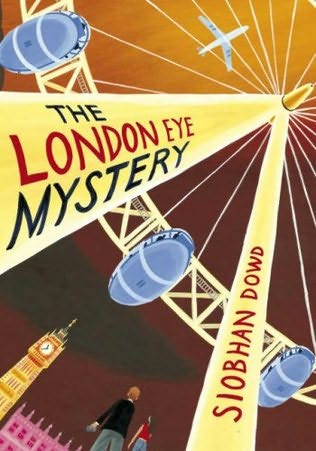
 When Aunt Gloria's son, Salim, mysteriously disappears from a sealed pod on the London Eye, everyone is frantic. Has he spontaneous combusted? (Ted's theory.) Has he been kidnapped? (Aunt Gloria's theory.) Is he even still alive? (The family's unspoken fear.) Even the police are baffled. Ted, whose brain runs on its own unique operating system, and his older sister, Kat, overcome their prickly relationship to become sleuthing partners. They follow a trail of clues across London in a desperate bid to find their cousin, while time ticks dangerously by.
I wouldn't say that this was a bad read, but it was a little boring, as far as mysteries go. But I will get to that later. I was expecting Ted to be annoying, but he is a surprisingly likable character. Kat is the annoying one, and I wished several times that she would disappear and never return.
That said - on to the mystery. It was not as involved as I was hoping. The Reader does not get the pleasure of solving the case with the characters (though I figured out about half of the answers fairly quickly), but instead only receive part of Ted's thought process so we are almost as much in the dark as everyone else. It can be annoying. Every mystery Reader wants to be given the opportunity of following their "detective's" thought patterns so they can feel as if they are assisting in solving the case. All in all, the mystery was a disappointment and was wrapped up in a manner that left me feeling a little sad and bereft of concern for the characters themselves.
Despite the mystery's lack of real interest, I have to say that I enjoyed the Author's writing. I love British writers - there is a quality to their style that is lost in a lot of other literature. At times, it might be difficult for someone who doesn't know much about British terms, but there are not too many instances like that. I usually dislike modern-set stories (who wants to read about the 21st century? We live it, after all), but Siobhan Dowd's writing made all the difference and kept me interested enough to finish the book.
Star Rating: 3/5 (liked it)
 For fourteen-year-old (soon to be fifteen) psychic investigator Gilda Joyce, a summer internship at the Washington, D.C., International Spy Museum gives her the perfect opportunity to sport her vintage spywear, cavort with real C.I.A. agents, and expand her knowledge of gadgetry and surveillance. But when the spy museum acquires new Cold War-era artifacts from a former Soviet spy, things get a little . . . weird. Suddenly, the ghost of Abraham Lincoln haunts Gilda's dreams, and a mysterious spectral woman with a bloodstained star keeps appearing in spy museum exhibits. Seeing her chance to solve a mystery, Gilda takes the case, but she soon finds out that she's in far deeper than she imagined. After intercepting a "dead drop" - a spy's encoded message hidden in a Washington, D.C. cemetery - Gilda realizes her case is not only a matter of investigating the supernatural; she's involved in an urgent matter of national security.
Gilda Joyce, Psychic Investigator, Gilda Joyce and the Ladies of the Lake, and Gilda Joyce and the Ghost Sonata - the three preceding books to this one - were disturbing, and I'm not entirely certain why I read the next two after the first one. They weren't good right-before-bedtime reads, and some of the content pertaining to the murders was disconcerting (i.e. in one of them, a girl almost purposely takes a drug overdose because she's tired of living). What I did like about the other three as opposed to The Dead Drop was the fact that at the end, Jennifer Allison did not specify whether or not there actually was a ghost. She more or less left it up to the Reader; a ghost could have actually been involved, but at the same time she offered a realistic, plausible explanation. The Ghost Sonata is when she stopped doing this and got ghosts more involved.
In The Dead Drop, there is no question of there being ghosts. The Dead Drop is not as disturbing as the other three, and I was able to read it comfortably before going to bed. There are some instances that are, of course, spooky, but not quite in the same way as, say, The Ladies of the Lake.
But the main reason I keep reading Gilda Joyce is because while actual ghosts are involved, the stories themselves really are intriguing mysteries, and Gilda herself is a very fun and unique character. I can share her love for vintage (though, in my opinion, she chooses the wrong era) and her love for working on a manual typewriter. There is simply no denying the fact that Gilda is a great heroine that keeps a Reader laughing. While the first three books have some pretty creepy and disturbing content, I think it can be a fun series to read. At times.
Star Rating: 3/5 (liked it)
Others in the Gilda Joyce Series:
1)Psychic Investigator
2)The Ladies of the Lake
3)The Ghost Sonata
4)The Dead Drop
5)The Bones of the Holy
 Don Giovanni is no beggar. A few months ago he was the wealthiest and handsomest young man in Messina, until a tidal wave washed away everything he owned. Though he's now homeless and poor, he still has his pride - and his good looks. Yet winter is coming, and Don Giovanni has nowhere to go, nothing to eat.
When a well-dressed stranger offers him unlimited wealth in exchange for a simple-sounding wager, Don Giovanni knows he shouldn't take it. Only the devil would offer a deal like this, and only a fool would accept. But Don Giovanni is desperate. Against his better judgment he enters into a deal with the devil: he will not change his clothes or bathe for three years, three months, and three days.
Beauty is a small price to pay for worldly wealth, isn't it? Unless Don Giovanni loses the wager - and with it, his soul.
The Wager is based off of an old Sicilian fairy tale, so you can assume that Don Giovanni actually does make a bargain with the devil. But that is as far as this book goes toward supernatural/magic content.
It has been a long time since I've read one of Donna Jo Napoli's books. I remember most of her stories with fondness and a little frustration toward her characters. Don Giovanni is aggravating, but The Wager is one of those tales where you don't particularly care for any of the characters (except Cani, his dog). You read it out of curiosity, and you finish it out of curiosity. I didn't care what happened to Don Giovanni, I didn't particularly feel sorry for him, and I didn't dislike him, either. It was very difficult, for some reason, to attach to Don Giovanni in any manner.
Which may partially be why this is a book that is difficult to get through. But it isn't the only reason. The Wager is not a book you should read while you are eating a meal, or if your stomach is empty. The whole premise of the story is how Don Giovanni copes with not bathing, changing his clothes, or combing his hair for three years, three months, and three days. Donna Jo Napoli likes detail, and when a story's premise is about someone who doesn't bathe for that long, you can imagine where her detail focuses. Dirt. Filth. Stench. The resulting effect on a person's physical health when they don't wash. It would turn anyone's stomach. On top of that, the devil finds various ways to make Don Giovanni's filth increase, and there is a particular incident that is really disgusting. I had to stop reading because my stomach was so hungry, and it was turning to a degree that threatened to make me physically sick.
That, unfortunately, isn't the only content. Don Giovanni loves women, and everyone seems to give themselves freely to him. While there are no actual sexual scenes, there is lots of alluding to past relationships, as well as pleasant feelings compared to physical, intimate contact with a woman. Most of this is in the beginning of the book, and it isn't terribly explicit, but it is worth noting.
The Wager was an interesting story, but I don't think I'll buy it, and I certainly won't read it again. Definitely not for weak stomachs.
Star Rating: 2/5 (it was ok)

 Rated: PG