Wednesday, June 9, 2010

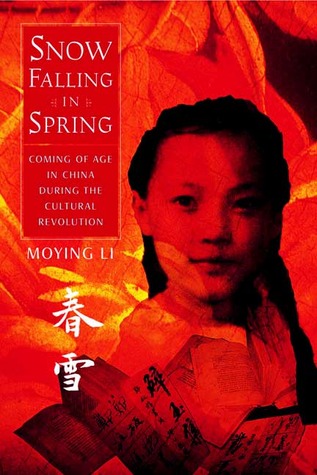
Snow Falling in Spring Review (Moying Li)


Moying Li is twelve years old when the Cultural Revolution sweeps across China. Studying at a prestigious language school in Beijing, she seems destined for a promising future. But everything changes when student Red Guards orchestrate brutal assaults, public humiliations, and forced confessions throughout the country. After watching her headmasters beaten in public, Moying flees school for the safety of home, only to find her beloved grandmother denounced, her house ransacked, and her baba taken away - along with his precious books. Struggling to make sense of her crumbling world, she finds sanctuary in literature. But with many schools shut down and most books forbidden, how can she keep her passion for learning alive? 


This book really makes you appreciate living in a country where you still have freedom. Again, this isn't a made-up story; it's a biography written by Moying Li. Her precise writing and insight into China - along with the blend of various Chinese words (and there is an index in the back for easy lookup) - make it a very interesting and easy read.

But it is also a hard read - especially for those who love books. Since it is during the Cultural Revolution, plenty of books are destroyed in the story, and those are very hard passages for any book-lover to read. The crimes committed by the Red Guard are horrendous; it left me staring in shock that they could get by with such monstrosities. It's not surprising, but every time I read a true account about such things, it always has the shocking effect on me. It left me feeling a little scared. My worst nightmare is to have my freedom taken away.

I don't really have anything negative to say about Snow Falling in Spring. It is very well-written, very engaging, very informative, and a strong recommendation from myself. I certainly intend to buy it.
 
Star Rating: 5/5 (this book was amazing)

Saturday, June 5, 2010

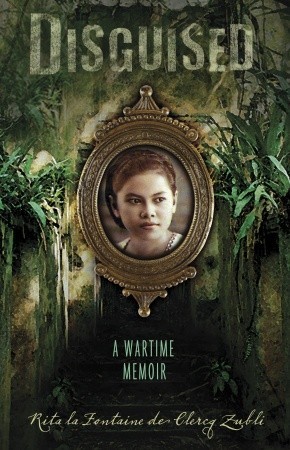
Disguised Review (Rita la Fontaine de Clercq Zubli)

With the Japanese army poised to invade their Indonesian island in 1942, Rita la Fontaine's family knew that they would soon become prisoners of war. One of their greatest fears was that 12-year-old Rita - their only daughter - would be forced to act as a "comfort woman" for the Japanese soldiers, so they launched a daring and desperate plan to turn Rita into "Rick." Rita's long dark hair was cut short, and she was dressed in boys' clothes. For the next three years, she carried out a dangerous charade.

This isn't a made-up story. It's true, and this book is written by Rita la Fontaine herself. It reads as both a biography and a novel, and the fact that every word of it is true makes it an even more engaging story than if it were a mere wartime novel. From the moment I started reading Disguised: A Wartime Memoir, I was enthralled and deeply interested in what happened to Rita. I was curious to see how she continued to maintain her disguise as she grew from a 12-year-old girl to a 14-year-old. It's really amazing how she pulled it off!

What most impressed me with Rita la Fontaine's writing was how she dealt with delicate scenes. There are plenty of them, but Rita never finds it necessary to go into detail. She gives a clear picture of what is going on in as few words as possible, while also giving insight into how a 12-year-old girl perceives such situations. There is one part in particular, when Rita is attacked by a Japanese soldier, that the author handles particularly well in its telling. Again, the fewest words are used to explain what is going on, but the Reader gets a clear - but not overly explicit - picture of the situation.

The book also gives an interesting insight into the Japanese who occupied the Indonesian islands. Through the years of occupation, Rita encounters soldiers who are brutal, but she also encounters just as many - if not more - who do as much as they can for the prisoners of war and even go against their orders to burn the camps and prisoners within when Japan surrenders. It just goes to illustrate once more that people are people; you'll encounter the bad and the good in any place, and even during the time of war, Rita was able to consider many Japanese as her friends.

Disguised: A Wartime Memoir by Rita la Fontaine de Clercq Zubli is going on my Books to Buy list.

Star Review: 5/5 (this book was amazing)

Thursday, May 27, 2010

Aftershocks Review (William Lavender)

Synopsis: Jessie Wainwright, daughter of a prominent San Francisco physician, is determined to become a doctor herself, despite her father's opinion that the medical field is best left to men. But when a shameful family secret is revealed that undermines everything she stands for, Jessie nearly abandons her dream in order to make things right.

Then, in the midst of Jessie's turmoil, a far bigger disaster strikes - the great earthquake of 1906 - sending shock waves through Jessie's world and propelling her down a path she never would have expected. Amid the havoc and devastation of San Francisco, Jessie struggles to make sense of the blatant intolerance and brutal discrimination that her city harbors toward its Chinese immigrants - even during the worst natural disaster of the century.


As the aftershocks continue to reverberate, Jessie enlists the help of trusted friends, old and new, to help find the answers she has been seeking. Only then will she be able to stand up to her father . . . and at last break through the cultural and racial barriers of her time.


Review: Despite the synopsis, this really isn't a book absolutely filled with the harsh treatment of Chinese immigrants in San Francisco. Actually, I was very surprised at how well this topic was blended into the rest of the story; it was very tastefully done. As was everything else in this book. I, at first, was dubious about the writing style - I am not overly fond of third-person narrations. But it did not take long to grow fond of the writing style and characters - especially as Jessie grows from a 14-year-old girl to a young woman. She is irritating, reckless, and naive at first, but she gradually changes and becomes wiser as she becomes older. I was especially pleased with how the author, William Lavender, handled the delicate nature of the "family secret." He did not dance around the subject - which is good, since it is a prominent key to the plotline, - but he did not find it necessary to go into great and unnecessary detail concerning certain aspects of the secret.


My all-time favorite character in Aftershocks was Alan Lundgren. I am always dubious of main male characters; it seems that nowadays authors like to throw an element into their leading male character(s) that is more than slightly annoying. It's been a long time since I've grown as fond of a leading character as I did Alan Lundgren. He was believable - not a perfect, faultless angel, but with flaws which he tried to conquer, and despite his faults, was a very good, decent, and kind person. I've never really liked optimistic characters - they tend to be very annoying, - but Alan's optimism is not.


There was one element to this story that I thought fell short. The earthquake. The aftermath of one of the most famous natural disasters in history was unbelievable. William Lavender did well in describing it and making the Reader see the devastation and danger. But when the earthquake itself hit . . . I barely blinked during that passage. I did not sit up straighter in my chair, nor did my breathing quicken or my fingers turn the book's pages faster. It was there, then it was gone. Almost like a slightly bigger ocean wave washing ashore - one that you might scamper away from, but feel no great alarm if it does happen to wet your feet. It did not have the proper feel of an earthquake, and I've experienced earthquakes before. Even the smallest ones are pretty terrifying.


Aside from that disappointing occurrence (and I was very much looking forward to the earthquake), it was a very interesting and good story. I encourage any who read it to give Jessie a chance - she is trying through the majority of Part One, but she is easier upon the Reader's patience by Part Two. She really does become a likable character, and if that turns out to not be the case, there are plenty others who do turn out to be very likable.Aftershocks by William Lavender will eventually find its way onto my bookshelves.


Star Rating: JJJ

Sunday, May 23, 2010

Leonardo's Shadow Review (Christopher Grey)


1497 Milan. It has been eight years since Giacomo was taken under the wing of the great Leonardo da Vinci. He had no memory of his past or where he came from, but he was quite satisfied to be known simply as Leonardo's servant - until now.

At fifteen, Giocomo's desire to discover his true identity has reached its peak. Leonardo claims to know nothing and wishes his servant would leave such questions alone. Torn between his obligations to his master and his search for the truth, Giocomo is pulled into a whirlwind of events that will threaten not only his own life, but also the fate of the entire city . . .
 
This isn't just a story about a boy trying to discover his identity - though a good portion of the book is spent on that. This book takes place during the time that Leonardo was painting The Last Supper, so that comes into play a lot as well - as does a few of Leonardo's inventions. It's a fun read for people who are familiar with Leonardo's work and the history surrounding this particular time in history.
 
That said, time to focus on the negative. I don't particularly like stories that are written in the present tense. It gives books waaaay too much of a movie feel, which detracts from the general splendor of the written word. This book is also written in first person, and I am fond of first person narratives. But there's something in Christopher Grey's first person style that I don't like, and it's not just the fact that it's coupled with present tense. He uses really short phrases a lot, giving the story a very choppy, moment-by-moment feel - again, movie-ish. It really takes away from the story.
 
And the story is good! It's an interesting read - if not a little too accurate in the way life was in 1497 Milan, and if one can get over some of the sexual hints. There is nothing explicit and nothing ever happens, but it's an element thrown in that gets a little tiring. Throw those things aside and the general writing style, and it's a good read.
 
Until you get to the end. Let it be known that there are a lot of plotlines running through this story, and they all get tied up. But some of the plotlines - namely, Giocomo's past and the mysterious items he is found being in possession of when Leonardo takes him in - are tied up loosely and leave the Reader disappointed. This isn't a book waiting for a sequel, so the loose-tying of the ends isn't a good element. It just leaves much to be desired.
 
I found Leonardo's Shadow interesting, but I don't think a copy will ever rest within my library as a permanent resident.

Star Rating: 2/5 (it was ok)