Showing posts with label mythology retelling. Show all posts

Sunday, June 5, 2011

Review: King of Ithaka - Tracy Barrett

Synopsis: Telemachos has a comfortable life on his small island of Ithaka, where his mother keeps the peace even though the land has been without its, his father, since the Trojan War began many years ago. But now the people are demanding a new king, unless Telemachos can find Odysseus and bring him home.

"Return to the place that is not, on the day that is not, bearing the thing that is not. On that day the king will return." With only this mysterious prophecy to guide him, Telemachos sets off over sea and desert in search of the father he has never known.

Review: My opinion on this story is divided, so I'll give the pros first. It is well written and very interesting - especially if you're familiar with The Odyssey. It isn't historical fiction, for Tracy Barrett keeps the mythical creatures like centaurs and mermaids in it, so it's more like a myth. However, it still has many rich historical details that flesh out the landscape and sometimes makes the Reader forget that it's not a true story.

And that, I am afraid, is where the pros end. While it is well written, the dialogue is so modern that it made me clench my teeth in frustration. And that wasn't the only thing that made me irritated. Telemachos has got to be one of the most aggravating adolescent heroes I've met. Okay, maybe that's a bit of an exaggeration - but he bloody well comes close to falling into that category. He's whiny, he spends all of his time ogling girls and getting drunk, he cannot fight or do anything useful, and he's always making stupid decisions. Hmm, nope - it's not an exaggeration after all! Telemachos's centaur friend - Brax - is okay, if only because he doesn't narrate the story like Telemachos does, and Polydora is not nearly as annoying as I was expecting her to be. In fact, she wasn't annoying at all - just kind of . . . bland. I could not have cared less about what happened to any of them.

There isn't really any sexual content, but the guys spend plenty of time talking about girls and ogling girls, as I mentioned above, but it's more of just a nauseating element than anything else. Probably what ticked me off most about this book was how Odysseus was portrayed. The only decent hero in Greek legend and the Author turns him into a wife-beater. Literally.

All in all, King of Ithaka was interesting and I don't regret reading it, but I probably won't be adding it to my collection. If I do, it's at the bottom of my list.

Overall Rating: 
KK

Thursday, June 2, 2011

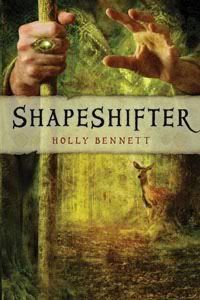
Review: Shapeshifter - Holly Bennett

Synopsis: In the world of Tir na nOg, shapeshifters and other such "natural" magic is not unusual. But Sive is gifted not only with the ability to shapeshift - her chosen form being a deer -, but a beautiful singing voice from her mother, which has the ability to incite whatever feelings she wants in listeners - be they sad, angry, passionate, or joyful.

But Sive, in her innocence, attracts the attentions of the Dark Man - a power-hungry sorcerer named Far Doirche who will stop at nothing to takeo ver Tir na nOg. And Sive's power is the key to achieving his desires.

In order to escape him, Sive must hide in her deer form, for he can only track her when she shapeshifts into a woman. But living as a deer most of the time may cost Sive her memory of what it is to be human, to be who she is. Her only refuge may lie in traveling across the invisible barrier that separates Tir na nOg from Eire - the mortal land of which the magical court of the Sidhe live side-by-side in mirror image, invisible to one another. There, she must seek the protection of Finn mac Cumhail, but even he may not be able to help her. For Far Doirche is a very patient sorcerer . . . and Sive can only hide for so long. . .

Review: Holly Bennett is a fantasy writer who does her research into iron-age/medieval periods in which she bases her stories. Her magical worlds have the same feel as the old Britannic legends (and not just because she has a fascination with Ireland and the British Isles and bases some of her stories there), and her characters are all very in depth and extremely likeable. She is the only Author who has ever made me attach to a character who was an Elf - and believe me, that is a feat to accomplish.

Shapeshifter is just as good as her Bonemender Trilogy, if not better. She plays upon the legends of Finn mac Cumhail (or Finn MacCool, as most of know him) and Oisin in a very interesting and new way, making the stories feel fresh. Her writing style brings things to life in a way most fantasy writers can't because their personal style is tainted with "modern phraseology". She also does something very interesting with first-person narration. The majority of the book is written in third person, but at times she has certain characters "remember" - which is when they take time to recall events that occurred, giving their own personal opinion on what happened. At first, this seemed very odd and somewhat random, but after a time, I grew used to it and enjoyed those parts the most. Some of Holly Bennett's transitions are a little rough, but she manages to cover a span of years very smoothly.

The only complaint I really have is that the demise of Far Doirche isn't as satisfying as I was expecting it to be. And yet, once I had time to reflect on the story, I decided that I actually rather liked it. His ending isn't cliched, there is no big showdown between hero (or heroine) and the big baddie. Honestly, it fit, and I don't feel as disappointed about it as I initially did.

The content is, for the most part, nonexistant. It is mentioned that Sive beds with Finn mac Cumhail, but that's all that is said. No details of any sort; just a frank statement and that is that.


Shapeshifter by Holly Bennett was a resounding success, in my opinion, and I look forward to adding it to my collection.

Overall Rating: 
{{{{

Sunday, January 30, 2011

Review: Nobody's Prize - Esther Friesner

Synopsis: Young Helen of Sparta is not about to be left behind when her older brothers head off to join the quest for the Golden Fleece - why should boys get to have all the fun? Accompanied by her friend, the ex-slave Milo, and disguised as a boy herself, Helen sets out to join the crew of heroes aboard the fabled ship the Argo. But even with the best-laid plans, it takes all of Helen's wits, plus a favor or two, for their voyage to begin - a voyage that will bring many changes for our determined heroine.
Helen quickly faces all sorts of danger and intrigue. Not only does she have to avoid her brothers' detection, a devastatingly handsome boy catches her eye and Hercules falls in love with her boy-self. There are battles to be fought, as well as an encounter with a terrifying murderous princess. But that's only the beginning! With her beauty blossoming, Helen's journey takes her beyond the mythology of the Golden Fleece to Athens, where her very future as Queen of Sparta is threatened.

Review: This had more of a definite storyline than Nobody's Princess, and it was every bit as good. Helen continues to be a good, properly strong female heroine without being obnoxious and always disparaging against the male gender. I have always been a fan of the myth of the Golden Fleece, so I found this installment particularly fun. Esther Friesner's rendition of Jason was well in keeping with how I always suspected he may be, and her Medea was astounding. She brought new and further life to an already intriguing character; I know that whenever I read about her in the myths again, I will feel more as if I know her.

But mixed in with the adventure, the good characters, and all that, there were some delicate and disturbing content. Hercules really does fall in love with Helen's boy-self Glaucus. Resulting in Hercules's weapons bearer being quite jealous of Helen - yes, his weapons bearer doubles into Hercules's boyfriend as well. Now, I always suspected that Hercules was gay when I read the myths - I suspected that of most of the Greek heroes, except Odysseus, Jason, and Hector (the latter not necessarily a Greek hero, but I always liked him). But it was disturbing to read. Esther Friesner does not carry this to a ridiculous degree, though, and nothing actually happens. The other delicate matter the Author addresses is when Helen transitions from girlhood into womanhood by the arrival of a monthly event which we ladies detest. I'm never one who likes it when an Author brings in such issues into a story - it's invasive, though realistic, but there are some realistic matters that one need not address. One of the attractions of literature is we get a chance to live in a world where daily functions are modestly ignored. But Esther Friesner deals with this issue very delicately, with careful and few words, and it actually does serve to introduce an important plot development.


What I found most disappointing was the end. It isn't abrupt or lacking - nothing like that. But I was sad to discover that the Author gives no explanation as to why it is Helen eventually marries Prince Menelaus. He's featured very briefly and there's no indication that Helen would ever consider him as a husband. I had waited in anticipation for this - what did Helen see in Menelaus that resulted in such an intimate tie? And then nothing.


Still, I will buy Nobody's Prize to add to my collection, and if you enjoyed Nobody's Princess, you'll enjoy this one, too.


Overall Rating: 
JJJ
Other Books in This Series:
1)Nobody's Princess
2)Nobody's Prize

Thursday, January 20, 2011

Review: Nobody's Princess - Esther Friesner

Synopsis: She is beautiful, she is a princess, and Aphrodite is her favorite goddess, but something in Helen of Sparta just itches for more out of life. Unlike her prissy sister, Clytemnestra, she takes no pleasure in weaving and embroidery. And despite what her mother says, she's not even close to being interested in getting married. Instead, she wants to do combat training with her older brothers, go on heroic adventures, and be free to do what she wants and find out who she is. Not one to count on the gods - or her looks - to take care of her, Helen sets out to get what she wants with determination and an attitude. And while it's the attitude that makes Helen a few enemies (such as the self-proclaimed "son of Poseidon," Theseus), it's also what intrigues, charms, and amuses those who become her friends, from the huntress Atalanta to the young priestess who is the Oracle of Delphi.

Review: At first, I was concerned that Helen was going to be the typical man-hating, I-can-do-anything, noodle-arms, flirtatious girl that so often populates modern literature. And I was not certain that I would be able to finish Nobody's Princess. But like Sphinx's Princess and its sequel Sphinx's Queen, Esther Friesner presents a strong female character who displays not the best common sense, but a will of iron and the correct attitude toward a life that tries to dictate how she ought to be. While I found her lack of planning things out, but going "with the flow," irksome, it was pretty much her only annoying trait.

The story itself lacks a main plotline, but rather follows Helen and her two brothers from place-to-place after they have delivered Helen's twin sister safely to her new home, and a main storyline is only revealed at the end. It's good that Esther Friesner wrote a sequel - Nobody's Prize. And since it picks up where Nobody's Princess leaves off, I trust that it will have a main plot. The lack of one in this one, though, isn't as annoying as you might think it. Plenty of interesting things still happen.

Another thing to note - if you are expecting this to be a sort of retelling of The Iliad, it isn't. It takes place way before the whole mess with Prince Paris and the city of Troy. It's a back-story, and it certainly makes me think of Helen differently when I now read The Iliad. I look forward to reading Nobody's Prize.


Overall Rating: 
{{{{

Others in This Series:
1)Nobody's Princess
2)Nobody's Prize