Thursday, June 9, 2011

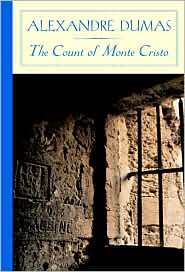
Review: The Count of Monte Cristo - Alexandre Dumas

For those of you who don't know, The Count of Monte Cristo concerns a young Frenchman, Edmond Dantes, who seems to have everything in life going right for him. He's to marry his beloved Mercedes, and he will soon be made a captain of a merchant ship. But one Fernand Mondego and Danglar frame him for being a Bonapartist, and Dantes is sentences to imprisonment in the Chateau d'If. After fourteen years, Dantes manages to finally escape and returns to France as the mysterious Count of Monte Cristo to avenge his ruined life.

Most of us think of this story with fondness because it has betrayal, romance, treasure, duels, poisoning, and revenge. I knew the gist of the story myself at an early age, and attempted to read a paperback copy when I was eight or nine. I didn't finish it, so thoroughly disappointed was I in discovering the true "lay of the land." Only recently did I buy a hardcover edition to replace my old battered paperback one, and only even more recently did I read its entirety.


I don't say this often - in fact, I think I have only said this once: the movie versions - especially the 2002 one with James Caviezel and Guy Pearce - are better than the book. This is a story that had a lot of potential, but because Alexandre Dumas wrote it, the majority of said potential was not taken advantage of. The first twenty chapters are good. The villains are introduced, Dantes is arrested and imprisoned, then he breaks out . . . and finds the treasure, which is when it starts to go downhill. For one thing, the treasure is one sad little box. Just one!! Massively disappointing for a nine-year-old, I can tell you that. Especially when every illustrated version I had looked at depicted the treasure as filling the entire cave (and I love how the cave is an underwater grotto in the 2002 film).


The Reader may then expect thirty chapters of pure blather. There is a mildly interesting scene involving Italian bandits (one of the male characters suffers us to read his comment on how he noted that many of the Italian bandits were quite handsome . . . Disturbing!), but Dumas manages to make that quite dull. I'm all for complicated revenge plans, but Monte Cristo carries it too far!! After thirty chapters, it picks up again for fourteen chapters, then sputters out for the last seven.


All in all, I found it a massive letdown. Again, the potential is there, but the plain truth is Alexandre Dumas is not a good writer. Oh, his style is okay - his dialogue often reads like a play, which can be a bit irritating at times. But there is nothing likable in his characters. Mercedes is a shallow woman, the villains really quite pathetic, and Dantes was likable up until the very end, when he runs off with a very young slave-girl (no, I am sorry, but he does not get reunited with Mercedes. I personally like the movie endings better, too). All the men are disturbingly light on their feet - especially the young dandies - and the women flighty and silly. And everyone is beyond melodramatic. Melodrama is fine when the Author is trying to make it humorous, but Dumas is a humorous writer (some of you may say that The Three Musketeers was light-hearted and humorous; that isn't the sort of humor I am speaking of).


Yes, The Count of Monte Cristo, while a good idea, falls quite short of the mark. I love classics and most of the time the Author's beautiful way of writing can make even the most boring story fun to read, but not so in Alexandre Dumas's case. College professors - those people who will say anything that makes them sound learned and lofty - may claim that Dumas is a masterful storyteller. I, a longtime bookworm and connoisseur of all things written, wholeheartedly disagree. The Count of Monte Cristo certainly is his best work, but that is only because it doesn't drag its feet the entire time.

So, if you are looking for a good classic to read and think to yourself, "Oh, I know the general gist of The Count of Monte Cristo. It sounds exciting!", stick to the movies. For once, they are actually better than the book.

Overall Rating: 
KK

Monday, June 6, 2011

Review: Rogue's Home - Hilari Bell

Synopsis: Sir Michael Sevenson and his squire, Fisk, can't seem to keep out of hot water. After five long years, Fisk has been called home to Ruesport to investigate who framed his sister Anna's husband, Max, as a blackmailer. Anna figures that Fisk, with his criminal past, is uniquely qualified to find out who set Max up. Of course Michael feels he has to come along to help his friend; but now he wears the tattoos of the unredeemed and fears he might be more hindrance than help.

Review: Like The Last Knight, Rogue's Home is hilarious - more so, in my opinion, than the first. There's fewer tongue-in-cheek type of jokes and the storyline is just more exciting. It picks up right where The Last Knight leaves off, so you definitely have to read them in order, even though this particular mystery isn't really connected to the one in the first book.

I think what I liked most about this one was the Reader gets to see more into Fisk's character and past. But at the same time, it doesn't just focus on him; the Reader also learns a lot about Michael as well.

I don't have anything negative to say about Rogue's Home. It's funny, it has great character and plot development, it's a wonderful mystery, and you definitely cannot put it down. I always doubt books that have little sayings on the back saying "I couldn't put it down!" because that seems to be the coined phrase for bad stories. And I hate to pin such a label on Rogue's Home, but I do mean it quite literally when I say that I could not put Rogue's Home down. I would not go to bed last night until I finished it, it was that good.

Can't wait until Player's Ruse comes in at the library!

Overall Rating: 
|||||

Others in the Rogue & Knight Series:

1)The Last Knight
2)Rogue's Home
3)Player's Ruse

Sunday, June 5, 2011

Review: King of Ithaka - Tracy Barrett

Synopsis: Telemachos has a comfortable life on his small island of Ithaka, where his mother keeps the peace even though the land has been without its, his father, since the Trojan War began many years ago. But now the people are demanding a new king, unless Telemachos can find Odysseus and bring him home.

"Return to the place that is not, on the day that is not, bearing the thing that is not. On that day the king will return." With only this mysterious prophecy to guide him, Telemachos sets off over sea and desert in search of the father he has never known.

Review: My opinion on this story is divided, so I'll give the pros first. It is well written and very interesting - especially if you're familiar with The Odyssey. It isn't historical fiction, for Tracy Barrett keeps the mythical creatures like centaurs and mermaids in it, so it's more like a myth. However, it still has many rich historical details that flesh out the landscape and sometimes makes the Reader forget that it's not a true story.

And that, I am afraid, is where the pros end. While it is well written, the dialogue is so modern that it made me clench my teeth in frustration. And that wasn't the only thing that made me irritated. Telemachos has got to be one of the most aggravating adolescent heroes I've met. Okay, maybe that's a bit of an exaggeration - but he bloody well comes close to falling into that category. He's whiny, he spends all of his time ogling girls and getting drunk, he cannot fight or do anything useful, and he's always making stupid decisions. Hmm, nope - it's not an exaggeration after all! Telemachos's centaur friend - Brax - is okay, if only because he doesn't narrate the story like Telemachos does, and Polydora is not nearly as annoying as I was expecting her to be. In fact, she wasn't annoying at all - just kind of . . . bland. I could not have cared less about what happened to any of them.

There isn't really any sexual content, but the guys spend plenty of time talking about girls and ogling girls, as I mentioned above, but it's more of just a nauseating element than anything else. Probably what ticked me off most about this book was how Odysseus was portrayed. The only decent hero in Greek legend and the Author turns him into a wife-beater. Literally.

All in all, King of Ithaka was interesting and I don't regret reading it, but I probably won't be adding it to my collection. If I do, it's at the bottom of my list.

Overall Rating: 
KK

Friday, June 3, 2011

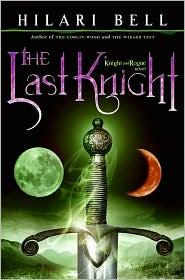
Review: The Last Knight - Hilari Bell

Synopsis: Knight errants don't exist anymore; such an occupation became obsolete a long, long time ago. So what is a rogue - a good-for-nothing, a real dastardly little con artist - like Fisk doing serving the world's last and only knight errant - Sir Michael Seven Oaks - in existence? That's what happens when helpful jerks like him rescue you from the noose.

For all of his complaining, though, Fisk certainly cannot disagree about one thing: with Sir Michael, he sees more than enough adventure. And their latest "gallant" escapade has seen the escape of a nefarious murderess, the Lady Ceceil, from a tall tower that only a damsel in distress should occupy, and of course Fisk and Sir Michael are the ones who must recapture her. Personally, Fisk would rather conveniently forget about the whole mess.


But something's very fishy about the circumstances surrounding Lady Ceceil's supposed poisoning of her husband, and Fisk and Michael soon find themselves acting as detectives to discover the truth. And there's lots of people who don't want them to find anything out.


Review: One word: hilarious. I usually hate characters like Fisk - no honor, "dashing" rogue, womanizer, irritating sarcasm (I love sarcasm, but not the type that's usually employed by adolescent males). Fisk is certainly a womanizer (more on that later), but he's hilarious in every other respect. Few books cause me to laugh out loud; this one did.


Michael, too, was not without his sarcasm. Hilari Bell used a very interesting method of first person narration that works very well when done properly: she switches narrators every other chapter, rotating between Fisk and Michael. She does it very well, giving an opportunity to represent both of their opinions, which livens the story up even more.


Unfortunately, sometimes the humor leans towards the immature college type of humor (this is mostly Fisk's doing), involving certain body parts and such things as those. There isn't so much that it makes it unreadable, but the times that it does appear, it's very annoying.


For the most part, though, The Last Knight was good. I look forward the next one.

Overall Rating: 
|||||

Others in the Rogue & Knight Series:
1)The Last Knight
2)Rogue's Home
3)Player's Ruse

Thursday, June 2, 2011

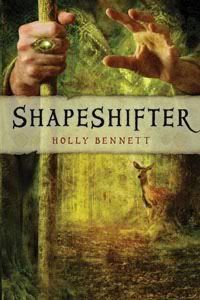
Review: Shapeshifter - Holly Bennett

Synopsis: In the world of Tir na nOg, shapeshifters and other such "natural" magic is not unusual. But Sive is gifted not only with the ability to shapeshift - her chosen form being a deer -, but a beautiful singing voice from her mother, which has the ability to incite whatever feelings she wants in listeners - be they sad, angry, passionate, or joyful.

But Sive, in her innocence, attracts the attentions of the Dark Man - a power-hungry sorcerer named Far Doirche who will stop at nothing to takeo ver Tir na nOg. And Sive's power is the key to achieving his desires.

In order to escape him, Sive must hide in her deer form, for he can only track her when she shapeshifts into a woman. But living as a deer most of the time may cost Sive her memory of what it is to be human, to be who she is. Her only refuge may lie in traveling across the invisible barrier that separates Tir na nOg from Eire - the mortal land of which the magical court of the Sidhe live side-by-side in mirror image, invisible to one another. There, she must seek the protection of Finn mac Cumhail, but even he may not be able to help her. For Far Doirche is a very patient sorcerer . . . and Sive can only hide for so long. . .

Review: Holly Bennett is a fantasy writer who does her research into iron-age/medieval periods in which she bases her stories. Her magical worlds have the same feel as the old Britannic legends (and not just because she has a fascination with Ireland and the British Isles and bases some of her stories there), and her characters are all very in depth and extremely likeable. She is the only Author who has ever made me attach to a character who was an Elf - and believe me, that is a feat to accomplish.

Shapeshifter is just as good as her Bonemender Trilogy, if not better. She plays upon the legends of Finn mac Cumhail (or Finn MacCool, as most of know him) and Oisin in a very interesting and new way, making the stories feel fresh. Her writing style brings things to life in a way most fantasy writers can't because their personal style is tainted with "modern phraseology". She also does something very interesting with first-person narration. The majority of the book is written in third person, but at times she has certain characters "remember" - which is when they take time to recall events that occurred, giving their own personal opinion on what happened. At first, this seemed very odd and somewhat random, but after a time, I grew used to it and enjoyed those parts the most. Some of Holly Bennett's transitions are a little rough, but she manages to cover a span of years very smoothly.

The only complaint I really have is that the demise of Far Doirche isn't as satisfying as I was expecting it to be. And yet, once I had time to reflect on the story, I decided that I actually rather liked it. His ending isn't cliched, there is no big showdown between hero (or heroine) and the big baddie. Honestly, it fit, and I don't feel as disappointed about it as I initially did.

The content is, for the most part, nonexistant. It is mentioned that Sive beds with Finn mac Cumhail, but that's all that is said. No details of any sort; just a frank statement and that is that.


Shapeshifter by Holly Bennett was a resounding success, in my opinion, and I look forward to adding it to my collection.

Overall Rating: 
{{{{